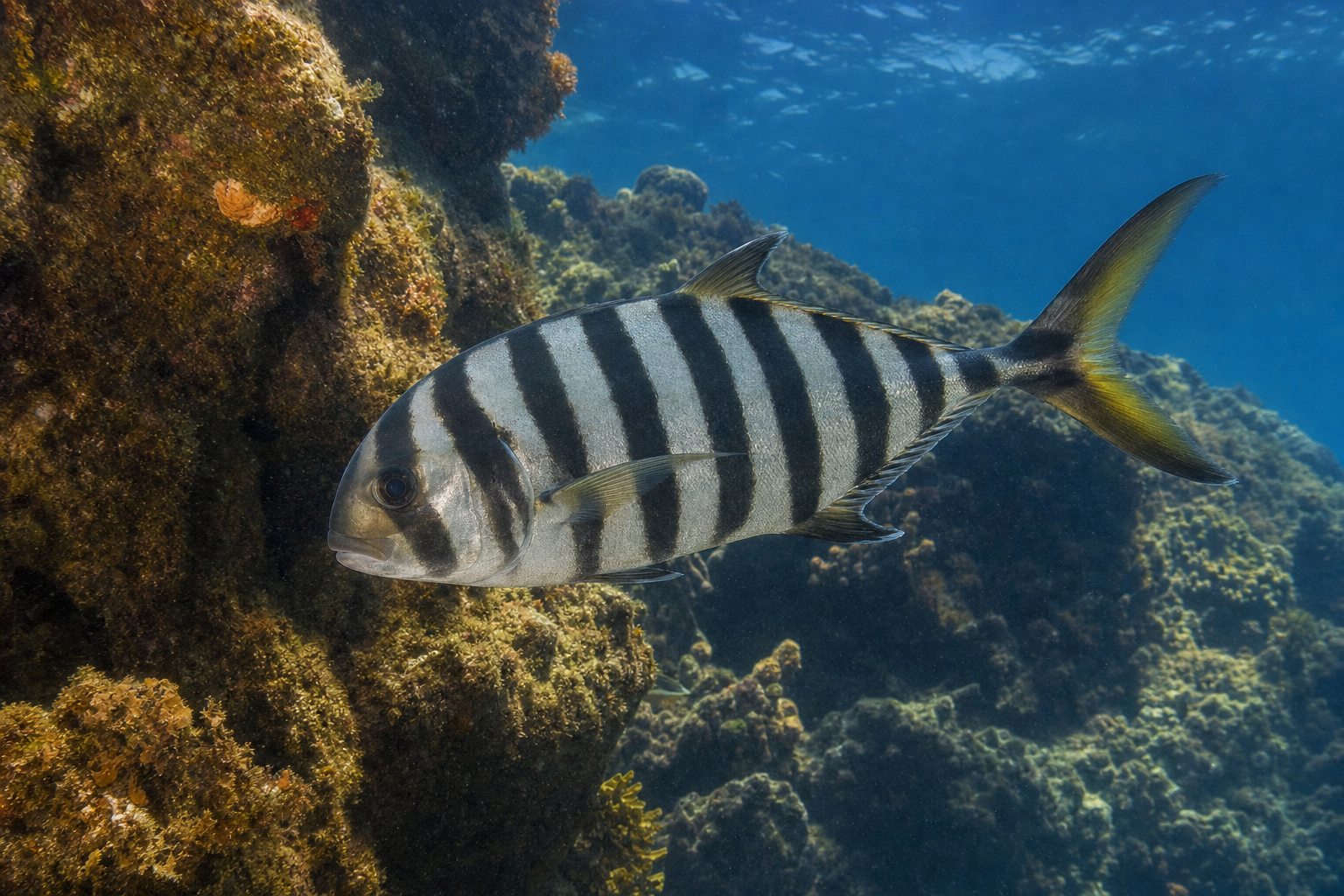
Banded Rudderfish
Identification
Banded rudderfish are a small member of the amberjack family, typically running 1 to 5 pounds with occasional fish to 8 pounds off the OBX. They have an elongated, moderately deep body with a dark olive-green to brown back, silver sides, and a distinctive dark stripe running from the eye to the tail. Juvenile banded rudderfish have bold vertical bars on the body that fade as the fish matures — these bars are the key identifier and give the species its common name. The body shape is more slender than greater amberjack but deeper than almaco jack. The second dorsal fin is not as dramatically elongated as in almaco jack.
Habitat and Behavior
Banded rudderfish are found on nearshore and offshore reefs, wrecks, and hard-bottom areas off the Outer Banks. They are more commonly found in shallower water than greater amberjack, often on reefs in 30-80 feet of water. Juvenile banded rudderfish are also frequently found around floating structure, Sargassum, and even buoys and channel markers. They are schooling fish that often mix with lesser amberjack and small almaco jack around structure. Banded rudderfish feed on small baitfish, squid, and crustaceans, and they are active throughout the water column over reefs.
Fishing Techniques
Banded rudderfish are most often caught incidentally while bottom fishing or jigging for other species over nearshore reefs and wrecks. They respond readily to small jigs — both vertical knife jigs and cast-and-retrieve metal jigs. Drop a 30-60g jig to the bottom near wrecks and work it up through the water column. Banded rudderfish will also hit small soft plastics and bucktails tipped with squid. For live bait fishing, small minnows or squid on a dropper loop or high-low rig works well. Light tackle in the 15-30 lb class is ideal for banded rudderfish — they are fun, sporty fish on lighter gear.
Baits and Lures
For jigging, 30-60g knife jigs in blue/silver, pink, and glow patterns catch banded rudderfish. Small bucktails (1/2 to 1.5 oz) tipped with squid strips are also effective and are a classic OBX bottom fishing presentation. Small metal jigs (1/2 to 1 oz) in silver and chrome work well for casting around nearshore structure. For live bait, small cigar minnows, sardines, and squid strips on 3/0-5/0 hooks with 20-40 lb fluorocarbon leader are standard. Banded rudderfish are aggressive feeders and not picky — they will eat almost any small offering presented near structure.
Best Times and Locations on the OBX
Banded rudderfish are a summer species on the Outer Banks, appearing from June through October. They are found on nearshore reefs and wrecks in 30-80 feet of water — closer to shore than greater amberjack. Prime locations include the nearshore reefs off Oregon Inlet (the 4-mile reef area), the wrecks off Hatteras Inlet (the nearshore bottom structure), and artificial reefs along the OBX coast. Juvenile banded rudderfish are also commonly found around floating structure and Sargassum in Gulf Stream waters during summer. The nearshore reefs off Avon and Buxton can also hold banded rudderfish when warm water pushes close to shore.
Regulations
Banded rudderfish are part of the amberjack complex managed by the South Atlantic Fishery Management Council. As a member of the Seriola genus, they may be subject to the same aggregate regulations as greater and lesser amberjack. Check current SAFMC regulations for the amberjack complex bag limits, minimum sizes, and seasonal closures. In North Carolina state waters, specific regulations for banded rudderfish may apply. Always verify current regulations with NCDFW and SAFMC, as amberjack management measures are subject to frequent changes.