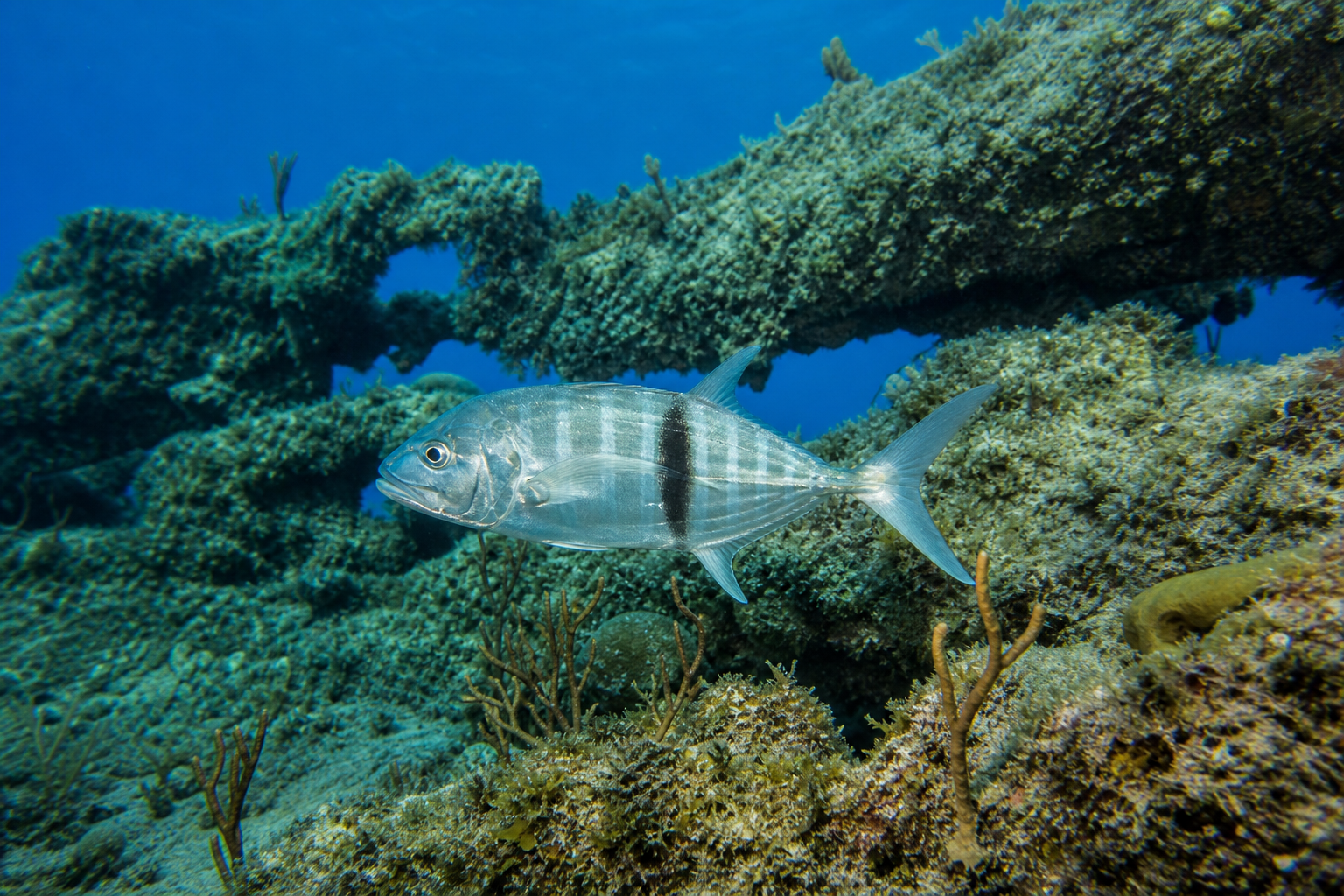
Bar Jack
Identification
Bar jacks are a sleek, attractive member of the jack family that occasionally appear in OBX offshore waters. They typically run 2 to 8 pounds, with occasional fish pushing 12 pounds. Bar jacks have a silvery body with a blue-green back and a distinctive dark stripe that runs from the lower jaw, along the back to the tail — this bar-like stripe is the key identifier and gives the species its name. The stripe can change intensity, appearing nearly black when the fish is excited or feeding. They have a deeply forked tail and a more slender, elongated profile than crevalle or blue runners.
Habitat and Behavior
Bar jacks are a tropical and subtropical species that range into OBX waters during summer months when warm Gulf Stream water pushes close to shore. They associate with reefs, wrecks, and floating structure — particularly Sargassum weed lines and floating debris in blue water. Bar jacks are schooling fish that travel in groups, often mixing with blue runners and small mahi around floating structure. They are active, fast-swimming predators that feed on small baitfish, squid, and pelagic crustaceans. Bar jacks are known to follow larger predators and pick off scraps, similar to blue runner behavior.
Fishing Techniques
Bar jacks are typically encountered as a bonus species while targeting mahi, tuna, or other offshore pelagics. When found around floating structure and weed lines, they respond readily to small jigs and live baits cast into the school. Small knife jigs (20-60g) in blue/silver and white work well — work them with a moderate-speed retrieve. Live bait fishing with small minnows or squid strips on light tackle is fun and productive. Bar jacks are not particularly leader-shy, but they have keen eyesight and respond best to a natural presentation. Light spinning tackle in the 10-20 lb class is ideal for bar jacks.
Baits and Lures
Small metal jigs (1/2 to 2 oz) in silver, blue/silver, and white are effective for bar jacks. Small epoxy jigs and soft plastic swimbaits in pearl or silver also produce. For live bait, small cigar minnows, sardines, and squid strips on 3/0-5/0 circle hooks with 20-40 lb fluorocarbon leader work well. Bar jacks are not fussy eaters — if you find a school around floating structure, they will usually eat whatever you offer. Small Clouser minnows and white streamers on fly tackle also catch bar jacks.
Best Times and Locations on the OBX
Bar jacks are a warm-water species that appears off the Outer Banks from June through October, coinciding with Gulf Stream proximity. They are most commonly encountered 20-50 miles offshore from Hatteras Inlet and Oregon Inlet, around weed lines, floating debris, and offshore reefs in blue water. The waters off Hatteras (the 280-380 line area) are the most productive, as the Gulf Stream runs closer to shore there. Bar jacks are less common than blue runners or crevalle jacks off the OBX, but they show up reliably in warm years. Look for them around the same floating structure that holds mahi.
Regulations
Bar jacks have no specific federal bag limit and no minimum size requirement. They are not subject to individual species management measures in the South Atlantic. In North Carolina state waters, there are no specific recreational regulations for bar jacks. As with all species, check with NCDFW and SAFMC for any regulation changes before your trip.