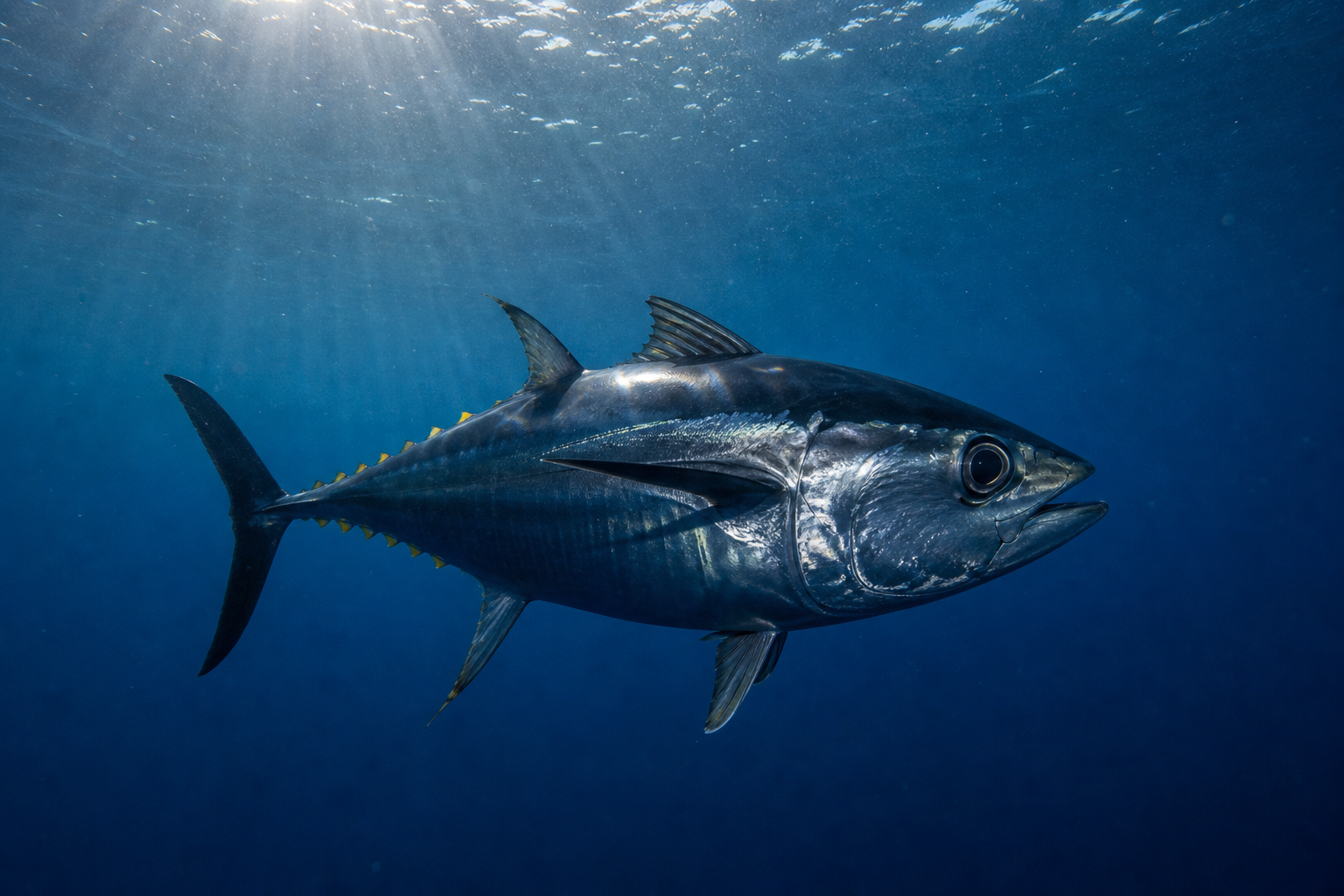
Bigeye Tuna
Identification
Bigeye tuna closely resemble yellowfin tuna but can be distinguished by their larger eyes, stockier body, and longer pectoral fins. They have a dark metallic blue back, silver sides, and a yellowish stripe along the flanks. The finlets are yellow with dark edges. Bigeye typically run 20 to 100 pounds off the OBX, though fish over 200 pounds are possible in deep Gulf Stream waters. Their oversized eyes are an adaptation to low-light feeding at extreme depths.
Habitat and Behavior
Bigeye tuna are a deep-water species that spends daylight hours at depths of 300 to 1,000 feet, following the deep scattering layer of prey organisms. They rise toward the surface at night to feed on squid, flying fish, and small pelagic fish. Off the Outer Banks, bigeye associate with temperature breaks along the shelf edge and in the deep blue water of the Gulf Stream. They prefer slightly cooler water than yellowfin (64-74°F) and are often found at the same temperature breaks that attract swordfish. Their deep-diving behavior makes them less accessible to standard trolling spreads and more often caught by specialized deep-water techniques.
Fishing Techniques
Nighttime chunking is the most consistent method for bigeye off the OBX. Anglers set up a squid or sardine chunk slick while drifting over the shelf edge in 100+ fathoms. Multiple rods deploy baits at varying depths, with a deep-line rig often targeting fish at 200-400 feet. Trolling at first light and last light can produce strikes when bigeye briefly rise to feed near the surface — standard tuna trolling spreads with ballyhoo and skirted lures work during these windows. A specialized technique borrowed from daytime swordfish fishing involves deep-dropping large live baits on electric reels during midday when bigeye are at maximum depth.
Baits and Lures
Squid is the premier bigeye bait — both for chunking and live baiting. Whole squid on circle hooks drifted in the slick are effective. Sardines and butterfish chunks build the slick. Live herring or small mackerel fished deep on weighted rigs account for trophy fish. For trolling, large skirted lures in dark colors (black/purple, blue/silver) trolled at 6-8 knots near temperature breaks produce bigeye strikes during low-light windows.
Best Times and Locations on the OBX
Bigeye tuna are a warm-season species, available May through October. They are found in the deep blue water beyond the shelf edge, typically 30-50 miles offshore from Oregon Inlet and Hatteras Inlet. The area near the Point (where the Gulf Stream meets the Labrador Current) and the canyons to the north are key locations. Charter boats running overnight trips or extended day trips from Hatteras target bigeye. Look for temperature breaks in the 68-74°F range along the shelf edge — these are the hallmarks of productive bigeye water.
Regulations
Bigeye tuna require an Atlantic HMS recreational permit. The recreational bag limit is typically 3 tuna (yellowfin, bigeye, and skipjack combined) per vessel per day, with a minimum size of 27 inches curved fork length. Commercial harvest requires a directed or incidental tuna permit. As with all HMS, regulations are subject to change based on stock assessments and international quotas. Verify current rules at NOAA Fisheries.