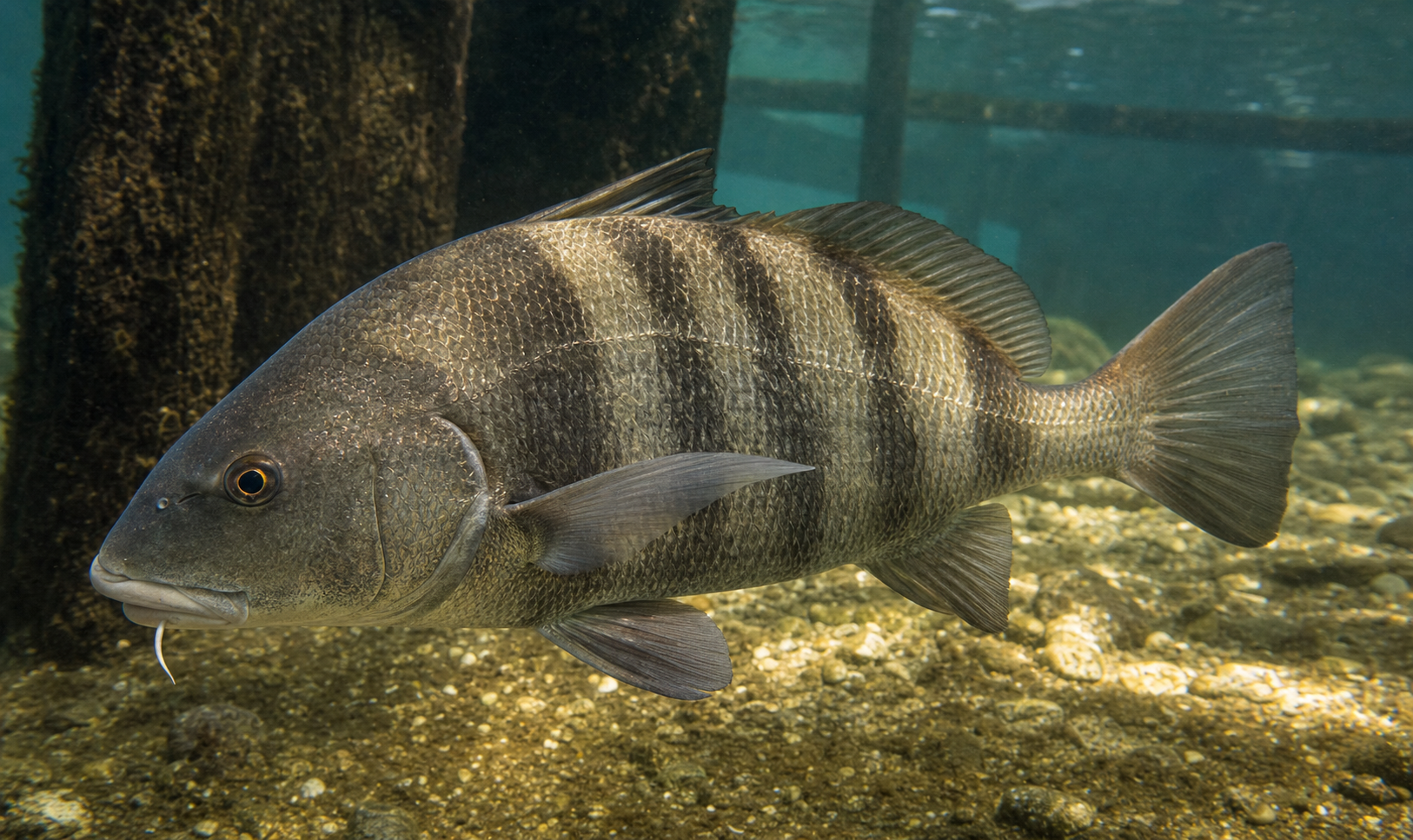
Black Drum
Identification
Black drum are the largest members of the drum family (Sciaenidae), capable of reaching over 100 pounds, though most caught on the OBX are juveniles in the 1-15 pound range. They have a deep, compressed body with a high, arched back. Coloration ranges from dark gray to black on the back and sides, fading to a white belly. Juvenile black drum (often called “puppy drum” though this term is also used for red drum) have distinctive vertical black bars on their sides that fade as the fish matures. Adults are uniformly dark. Black drum have large, heavy pharyngeal teeth (throat teeth) used for crushing shells, and they possess barbels on the lower jaw for detecting food on the bottom.
Habitat and Behavior
Black drum range from Massachusetts down through Florida and into the Gulf of Mexico. They are bottom-dwelling fish that prefer estuaries, inlets, and nearshore waters with muddy or sandy bottoms and significant structure. On the OBX, black drum are commonly found around pier pilings, inlet jetties, and bridge abutments, where they feed on clams, crabs, and oysters. Juvenile black drum are more likely to be caught in the surf and from piers, while larger adults tend to frequent deeper inlet waters and around structure. Black drum are long-lived fish that can survive for decades. They are less migratory than some other drum species but do move between estuarine and nearshore waters seasonally.
Fishing Techniques
Black drum are primarily bottom feeders that rely on smell and their barbels to locate food. The standard setup for targeting puppy drum (small black drum) from OBX piers and the surf is a fish-finder or Carolina rig with a 1-3 oz sinker and a circle hook or J-hook in the 1/0 to 4/0 range. Leader material should be 20-30 lb test, as black drum have rough mouths but aren’t particularly toothy. For larger drum around inlets, heavier gear is needed — 30-50 lb test leaders and 4-6 oz sinkers. Float rigs fished near pier pilings can also produce puppy drum, particularly when crabs are abundant around the structure. Black drum bites can be subtle at first — they often pick up the bait and mouth it before moving off.
Baits and Lures
Blue crab is the premier bait for black drum on the OBX. A half-crab or crab section (cracked so the scent releases) on a bottom rig is the standard approach for larger drum. For puppy drum, small pieces of crab, clam, and fresh shrimp all work well. Clam is an underrated bait for black drum — fresh surf clams or chowder clams fished on the bottom can be deadly, especially around pier pilings. Squid will catch puppy drum but is less selective, as everything eats squid. The key for black drum is fresh, natural bait with strong scent. Cut bait and artificial lures are generally not effective for this species.
Best Times and Locations on the OBX
Black drum are present in OBX waters from spring through fall, with April-May and September-October being peak periods. OBX piers — particularly Avalon, Nags Head, and Jennette’s — are reliable producers of puppy drum throughout the summer. Oregon Inlet and the catwalks under the Bonner Bridge are excellent for larger black drum, especially in the spring and fall. The surf near inlets, particularly Oregon Inlet and Hatteras Inlet, can produce drum as well. Cape Point at Hatteras is a legendary spot for large drum in the fall. Fishing around structure is key — pier pilings, bridge abutments, and jetty rocks all hold black drum. Night fishing can be particularly productive for larger drum, as they move into shallower water to feed after dark.
Regulations
Black drum are managed by the NC Division of Marine Fisheries. The minimum size limit is 14 inches total length. The recreational daily bag limit is 10 fish per person. Only one fish over 25 inches may be retained per person per day, protecting the large breeding adults. There is no closed season. Always check current NC DMF regulations before fishing.