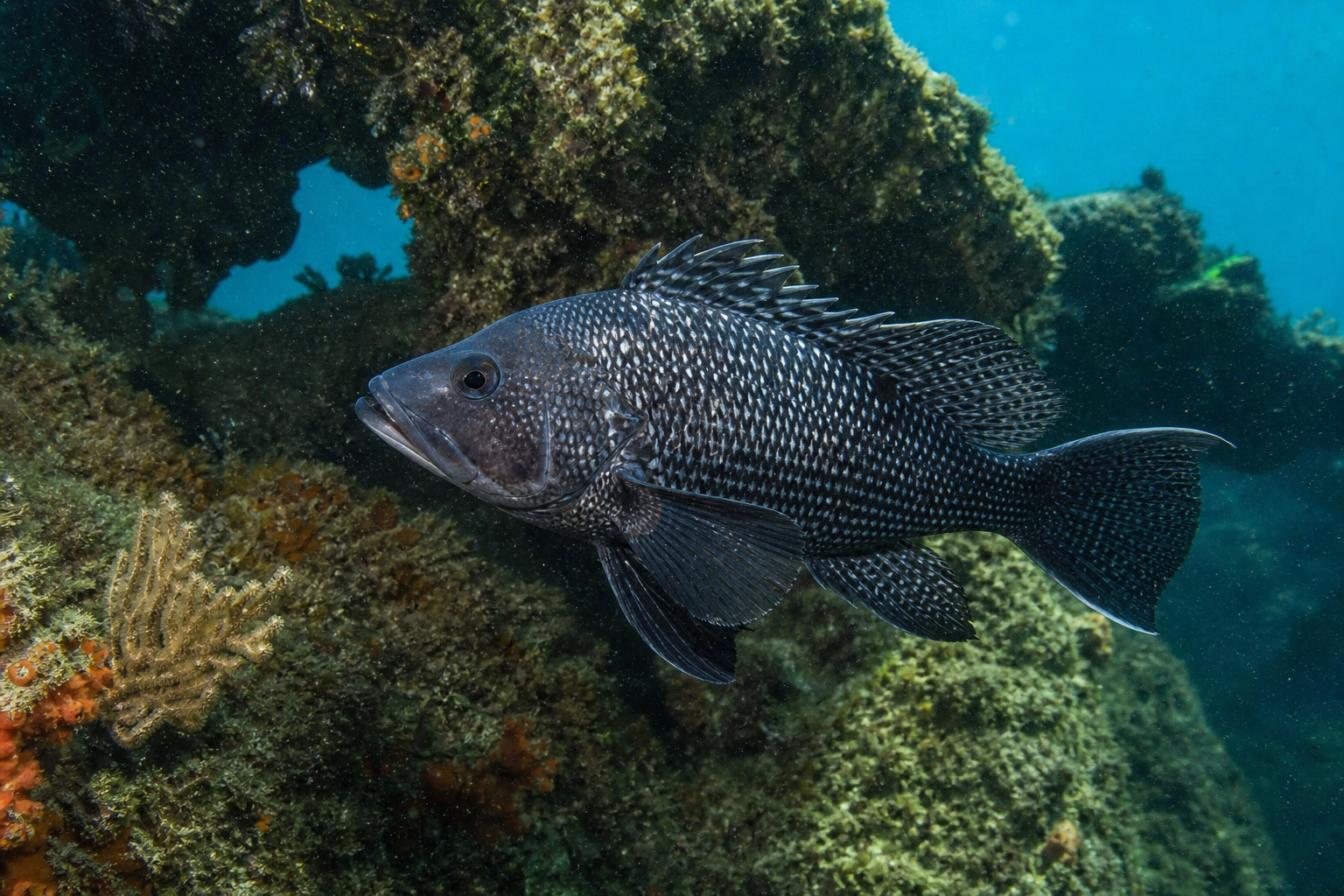
Black Sea Bass
Identification
Black sea bass are a stout, dark-colored bottom fish with a distinctive humpback profile, large mouth, and sharp dorsal spines. Their coloration ranges from dark brown to bluish-black, often with lighter mottling or faint vertical bars along the sides. Males in spawning condition develop a distinctive blue hump on their forehead and brighter coloration. They have a rounded caudal fin and a thick, meaty body. Black sea bass on the OBX typically range from 1 to 3 pounds, though specimens over 5 pounds are caught on deeper offshore structure. They are protogynous hermaphrodites, meaning they begin life as females and transition to males as they grow larger.
Habitat and Behavior
Black sea bass are structure-oriented fish that gravitate to hard bottom, wrecks, artificial reefs, and rocky ledges. On the Outer Banks, they are found on nearshore reefs within a few miles of the beach as well as on deeper offshore wrecks and structure out to 30+ miles. They are aggressive ambush predators that hold tight to structure, darting out to grab passing prey before retreating to cover. In spring, they migrate inshore as water temperatures rise, becoming available to nearshore anglers. During summer, they can be found on close-in reefs in 30 to 80 feet of water. As fall approaches and water cools, they move back to deeper offshore structure for the winter.
Fishing Techniques
Bottom fishing is the primary method for targeting black sea bass on the OBX. A two-hook bottom rig (also called a chicken rig) baited with squid or cut bait is the standard setup. Use a rod in the 30 to 50-pound class with a conventional reel spooled with braided line to maximize sensitivity and feel the bites in deeper water. Drift fishing over hard bottom and reefs is highly effective, allowing you to cover ground and find concentrations of fish. Vertical jigging with metal jigs or butterfly jigs can also produce quality fish, especially on deeper wrecks where larger bass hold. When fishing around wrecks, be prepared to lose tackle — these fish live in and around sharp structure that will cut off rigs.
Baits and Lures
Squid is the universal bait for black sea bass and is hard to beat. Cut squid strips, fished on a two-hook rig, will catch sea bass all day long. Fresh cut bait such as spot, croaker, or menhaden also works well. Bloodworms and sandworms are excellent for enticing larger sea bass and are especially productive on nearshore reefs. Artificial baits such as Gulp! shrimp and swimming mullets on jig heads can be deadly, particularly when tipped with a small piece of squid for scent. Small metal jigs and diamond jigs in the 2 to 4-ounce range work well for vertical jigging over deeper structure. The key is getting your bait to the bottom and keeping it there — sea bass rarely feed far above the structure.
Best Times and Locations on the OBX
Black sea bass are available from April through December on the Outer Banks, with the most consistent action from May through October. Nearshore reefs within 3 to 10 miles of Oregon Inlet and Hatteras Inlet are the most accessible and productive grounds. The AR (Artificial Reef) sites off the central OBX coast — including AR-165, AR-190, and AR-200 — are well-known sea bass producers. Wrecks such as the U-576 area and various known shipwrecks along the coast also hold good numbers. For shore-based anglers, sea bass can occasionally be caught from Oregon Inlet and Hatteras Inlet jetties, particularly in spring and fall when water temperatures are transitioning. Head boats out of Oregon Inlet and Hatteras regularly target sea bass on half-day trips.
Regulations
North Carolina recreational regulations for black sea bass require a 13-inch minimum total length and a bag limit of 10 fish per person per day in state waters (within 3 miles). In federal waters (beyond 3 miles), the bag limit is also 10 fish per person with a 12.5-inch minimum total length, but the recreational season may be closed during certain periods depending on annual harvest quotas. Always check current NOAA Fisheries and NC Division of Marine Fisheries regulations before heading out, as federal season closures can occur with short notice. A recreational fishing license is required for all anglers targeting black sea bass in NC waters.