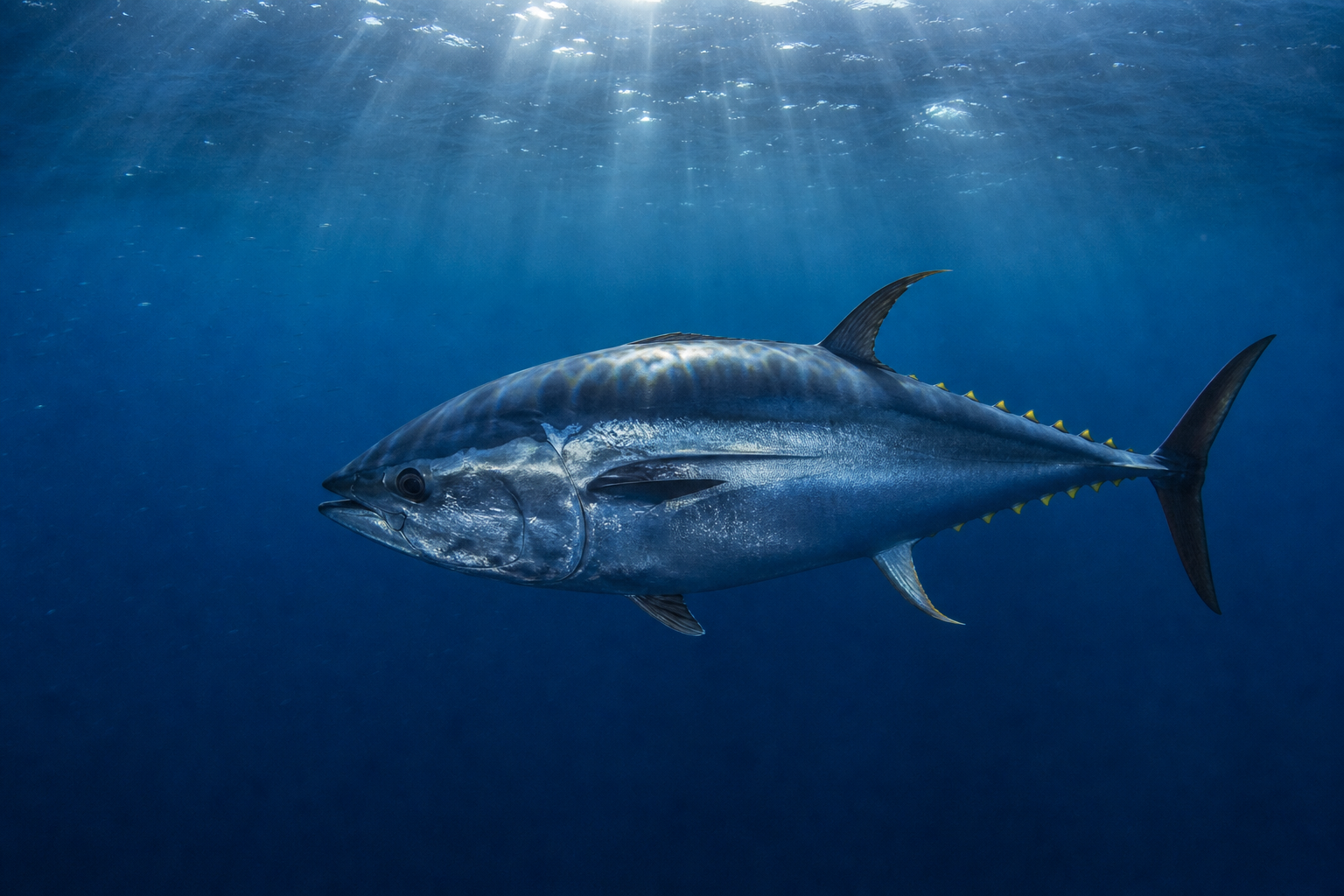
Bluefin Tuna
Identification
Bluefin tuna are the largest and most prized of the tuna species, capable of exceeding 1,000 pounds and reaching lengths over 10 feet. They feature a metallic dark blue-black back, silver-white belly, and a series of finlets between the dorsal and anal fins. The pectoral fins are short but distinctive, and the body is built for extreme speed and endurance. A keel on the caudal peduncle helps power their sustained swimming. Their flesh is dark red and rich in fat, which is why they are so highly valued in the sushi market.
Habitat and Behavior
Bluefin tuna are pelagic, highly migratory fish that travel across entire ocean basins. Off the Outer Banks, they appear during winter and early spring when cold-water forage is abundant near the shelf edge and inshore waters. They school by size class, with giant bluefin (over 73 inches) often traveling alone or in small groups, while school-size fish (27 to under 47 inches) form larger aggregations. They are endothermic, maintaining body temperatures above surrounding water, which allows them to hunt in cold water that other tuna avoid. They feed aggressively on menhaden, butterfish, squid, and herring, often driving bait to the surface in feeding frenzies visible for miles.
Fishing Techniques
The most productive OBX bluefin technique is chunking — deploying a slick of butterfish or menhaden chunks while drifting over known holding areas. Anglers deploy multiple rods with varying leader lengths to present baits at different depths in the slick. Trolling spreader bars, daisy chains, and cedar plugs work when fish are scattered or when covering water to locate schools. Live baiting with menhaden is devastating on giant bluefin when fish are holding nearshore, particularly off Cape Hatteras in winter. Heavy tackle is essential — 130-pound class reels, bent-butt rods, and 200-pound test leaders are standard for giants.
Baits and Lures
Butterfish are the gold standard for chunking bluefin off the OBX. Live menhaden are the top live bait for nearshore giants. Sardines, herring, and squid all work as chunk or live bait. For trolling, green machine spreader bars, daisy chains of cedar plugs, and Zuker-style lures in black/purple and green color patterns are proven producers. Z-Man Jag Pro and similar heavy jigs can trigger strikes from school-size fish feeding deep.
Best Times and Locations on the OBX
Winter is prime time for OBX bluefin, particularly January through March. Cape Hatteras is the epicenter — fish push close to shore following bait, sometimes within 3 miles of the beach. Oregon Inlet and Hatteras Inlet are the primary departure points. Spring brings a second run in May-July as fish follow warming water northward. Charter boats from Hatteras Harbor and Oregon Inlet Fishing Center target bluefin when conditions align. Watch water temperature breaks — bluefin love the 58-68°F range.
Regulations
Bluefin tuna are managed under the Atlantic HMS (Highly Migratory Species) permit system. Anglers need an HMS recreational permit to target, retain, or even catch and release bluefin. Size categories include school (27 to under 47 inches), large school (47 to under 73 inches), and giant (73+ inches), each with different daily retention limits that change by season. General category permits are for commercial harvest. Regulations change frequently based on quota — always check NOAA Fisheries HMS regulations before fishing.