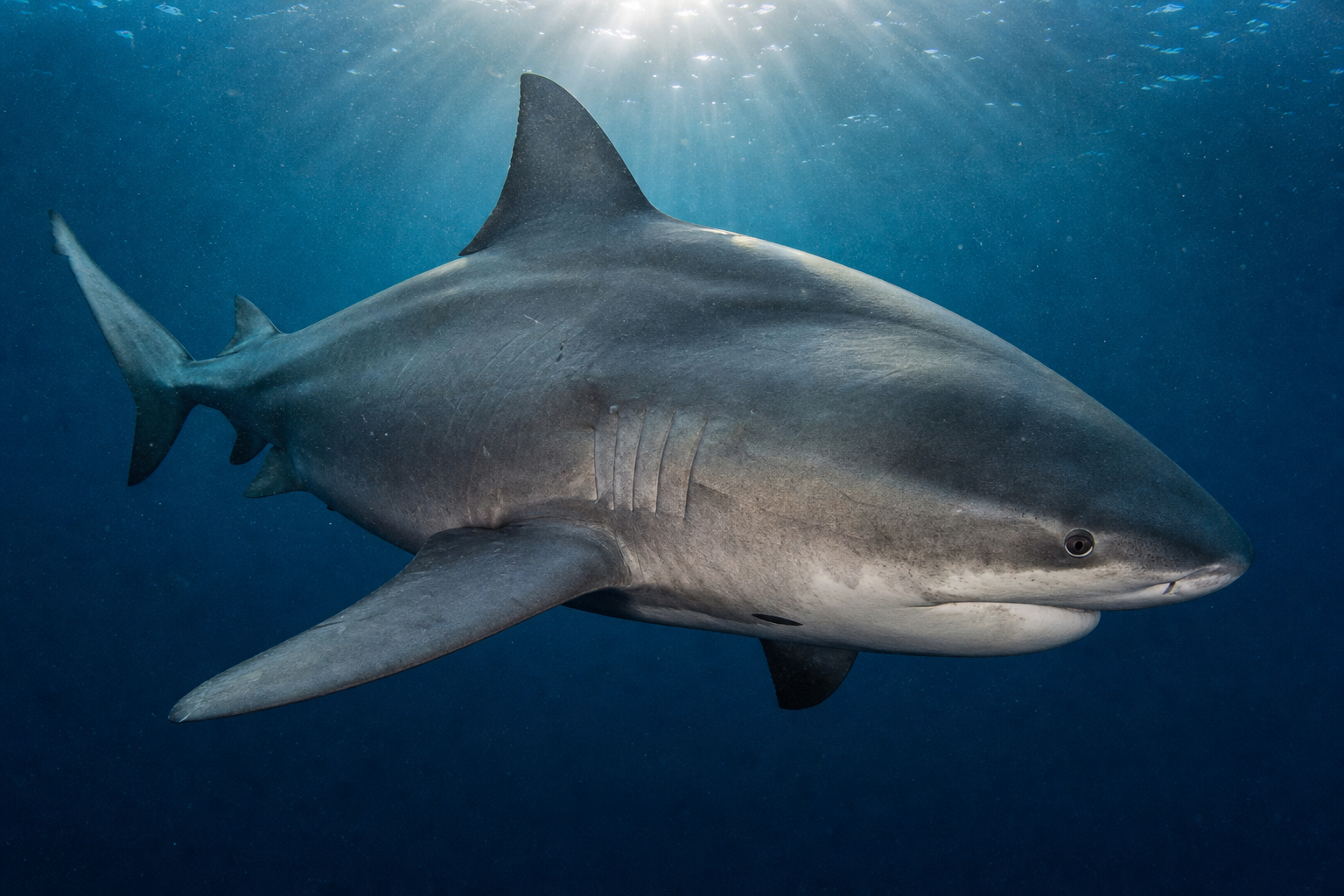
Bull Shark
Identification
The bull shark is one of the most powerful and aggressive sharks found on the Outer Banks. It is a heavy-bodied requiem shark that typically reaches 7 to 10 feet in length and can weigh over 300 pounds. The bull shark has a stocky, robust build with a broad, flat snout and a relatively small eye compared to its body size. The first dorsal fin is large and triangular, originating well behind the pectoral fins. The body is gray to grayish-brown above and pale below, with no distinctive markings. Bull sharks are often confused with sandbar sharks but can be distinguished by their thicker, more massive build and shorter, blunter snout.
Habitat and Behavior
Bull sharks are unique among OBX sharks for their ability to tolerate fresh and brackish water. They are found in the surf zone, inlets, sounds, and even river mouths. On the OBX, bull sharks are encountered in Pamlico Sound, around Oregon Inlet, Hatteras Inlet, and in the surf along Hatteras Island. They are aggressive, territorial predators that feed on fish, rays, other sharks, and even sea turtles. Bull sharks are known for their powerful, stubborn fighting style — they use their bulk to bulldoze rather than run. They are most active in warm water above 70 degrees and feed heavily at night and during tide changes.
Fishing Techniques
Bull sharks require serious gear due to their power and stubborn fighting style. For surf fishing, use a 12-13 foot heavy surf rod with a large conventional reel or heavy spinning reel, 50-80 lb braid, and a 100 lb minimum wire leader. A fishfinder rig with 8-12 oz of lead holds bottom in strong currents. Kayak delivery of large baits past the sandbar is standard at Cape Point. For sound and inlet fishing from a boat, drift or anchor near channel edges and drop-offs. Bull sharks tend to fight close to the bottom, using their weight to hunker down. Be prepared for a long, grueling battle — bulls do not give up easily. Keep pressure constant and use the rod’s backbone to lift the fish.
Baits and Lures
Fresh, large baits are essential for bull sharks. Live mullet, live bluefish, and live menhaden are top producers — the vibrations of a large live baitfish attract bulls from a distance. When live bait is unavailable, large chunks of fresh bunker or whole mullet fished on the bottom are effective. Bull sharks are scent-driven and respond strongly to the oily trail of fresh menhaden. Use a 10/0 to 12/0 circle hook on heavy wire cable. The bait should be substantial — a whole mullet or a large chunk of bunker, not a small piece. The fresher and bloodier the bait, the better.
Best Times and Locations on the OBX
Bull sharks are warm-water visitors to the OBX, present from May through October with peak activity in July and August. Cape Point at Hatteras is the top surf location, where bull sharks are regularly encountered during summer nights. Hatteras Inlet and Oregon Inlet are productive for both surf and boat fishing. The Pamlico Sound side of the islands, particularly around the deeper channels and near the inlets, holds bull sharks throughout the summer. The beaches of Ocracoke Island also produce bulls. Fish at night during tide changes for the best results. Warm water periods following sustained southerly winds push bull sharks closer to shore.
Regulations
Bull sharks fall under the large coastal shark management group in NC. The minimum size is 54 inches fork length in state waters. The recreational bag limit is 1 shark per person per day with a vessel limit of 1 shark per vessel per day, combined with other large coastal shark species. All sharks must be landed with head, tail, and fins naturally intact. There is no closed season in state waters. Due to their power and potentially aggressive nature, exercise extreme caution when handling bull sharks for release. Keep the shark in the water, use a dehooker, and never put your hands near the mouth. Cut the leader if the hook cannot be safely removed.