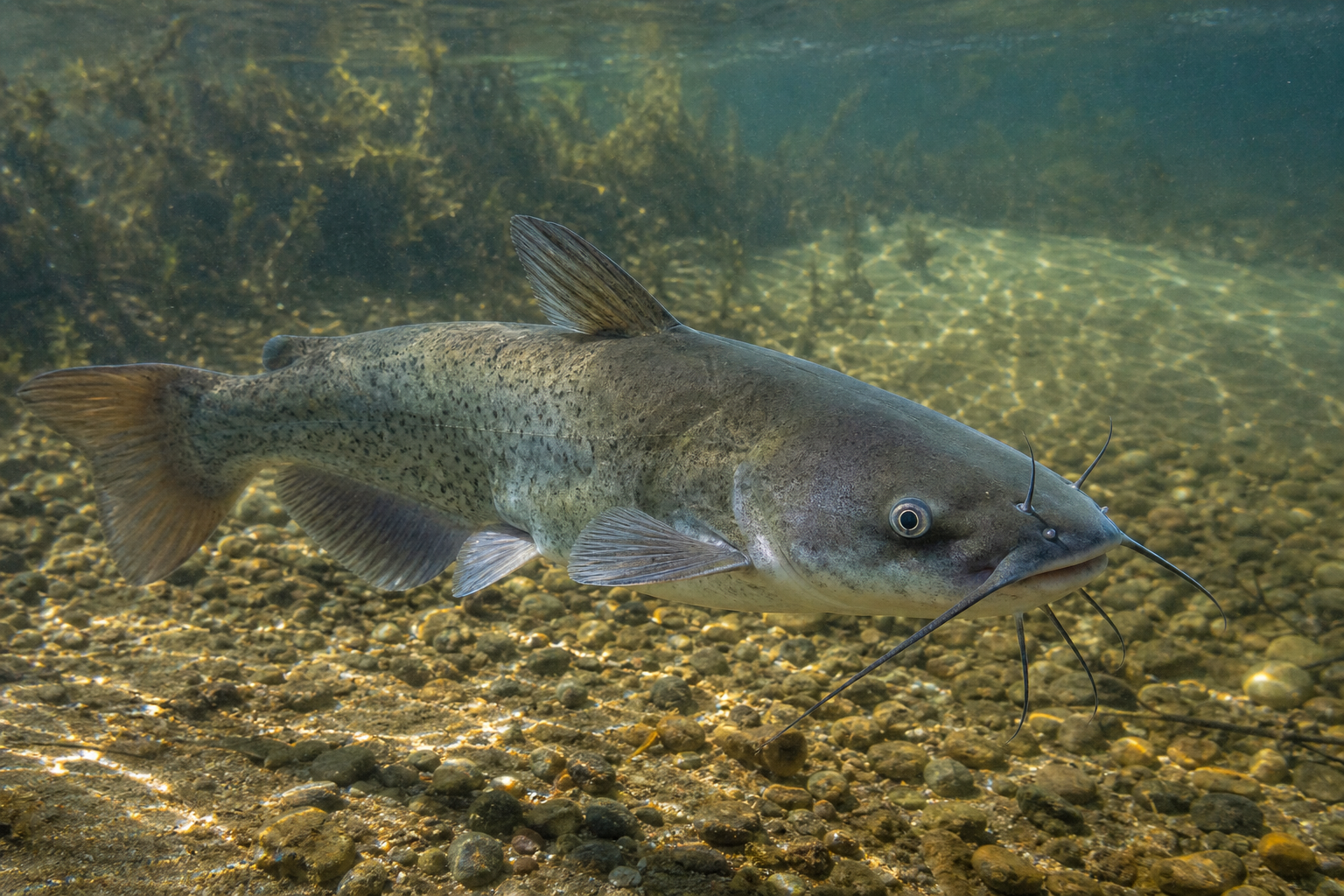
Channel Catfish
Identification
Channel catfish are the most common catfish species in OBX freshwater and brackish systems. They have a cylindrical body with a bluish-gray to olive-brown back, silvery-white sides, and a white belly. The tail is deeply forked — distinguishing them from the bullheads and flathead catfish also found in some OBX waters. They have the characteristic barbels (whiskers) around the mouth, with channel cats having a relatively small head and a spotted pattern on juveniles that fades in larger fish. Typical OBX channel cats run 1-5 pounds, with fish over 10 pounds being quality catches and fish over 20 pounds possible in the Albemarle tributaries.
Habitat and Behavior
Channel catfish thrive throughout the Albemarle and Pamlico Sound watersheds, particularly in the rivers and creeks that feed the sounds. The Roanoke River, Chowan River, Pasquotank River, Alligator River, and their tributaries all hold strong populations. Channel cats are adaptable, tolerating brackish water well into the sound margins, and are often found in canals and drainage ditches throughout the OBX mainland. They prefer deeper holes with moderate current, mud or sand bottoms, and structure like fallen trees or bridge pilings. Catfish are primarily nocturnal feeders, using their barbels and acute sense of smell to locate food in turbid water. They are omnivorous, eating fish, crustaceans, insects, and almost any organic matter.
Fishing Techniques
Bottom fishing is the standard approach for channel cats in OBX waters. A simple fish-finder rig (sliding sinker above a swivel, 12-24 inch leader, and a 2/0 to 4/0 circle hook) fished with cut bait or chicken liver is highly effective. Fish deeper holes in river bends, below bridge abutments, and at the mouths of tributary creeks. Slip bobber rigs suspended 3-6 feet deep work well in slack water and canals. Drift fishing with a bottom-bouncing rig covers water in the broader sound tributaries. For bank anglers, the bridges and canal banks along US-158 and NC-94 provide accessible catfishing. Trotlines and jug fishing are traditional methods in the Albemarle tributaries where regulations permit.
Baits and Lures
Cut bait is king for OBX channel cats. Cut menhaden (bunker) and cut herring are the top natural baits, releasing strong oils that draw cats from a distance. Chicken liver is a cheap and effective standby, particularly for smaller fish and in warmer water. Nightcrawlers and earthworms are universal catfish bait and work well in the fresher upper tributaries. Prepared stink baits (like Charlie’s or Sonny’s) fished on sponge or tube rigs can be deadly in summer. Live shad — if you can catch them — fished alive on a bottom rig will catch the largest channel cats, which are predatory. In the Currituck canals, fresh-cut bream (sunfish) is a local favorite.
Best Times and Locations on the OBX
Channel catfish are catchable year-round but are most active from May through October when water temperatures are warm. The Roanoke River near Plymouth and Williamston is a top catfish destination, with deep holes and current seams holding good fish. The Chowan River near Edenton and the tributary creeks of the Pasquotank River around Elizabeth City offer excellent catfishing. On the OBX mainland, the canals along US-158 through Currituck County are easily accessible and productive — fish near bridge crossings and culvert outlets. Summer nights are prime catfish time; fishing after dark with cut bait in the Albemarle tributaries can yield nonstop action. The Alligator River and its canals along NC-64 are another underutilized catfish spot.
Regulations
Channel catfish in OBX waters fall under NCWRC inland fishing regulations. There is no minimum size limit for channel catfish in most NC waters. Creel limits vary — many inland waters have no daily creel limit or a generous limit (10+ per day), but some water bodies have specific regulations. Trotlines, jug fishing, and set hooks may be permitted in certain waters with specific gear restrictions. A valid NC inland fishing license is required for recreational angling. Always check the current NCWRC Inland Fishing Regulations digest for waterbody-specific rules, especially when using set gear like trotlines or jugs.