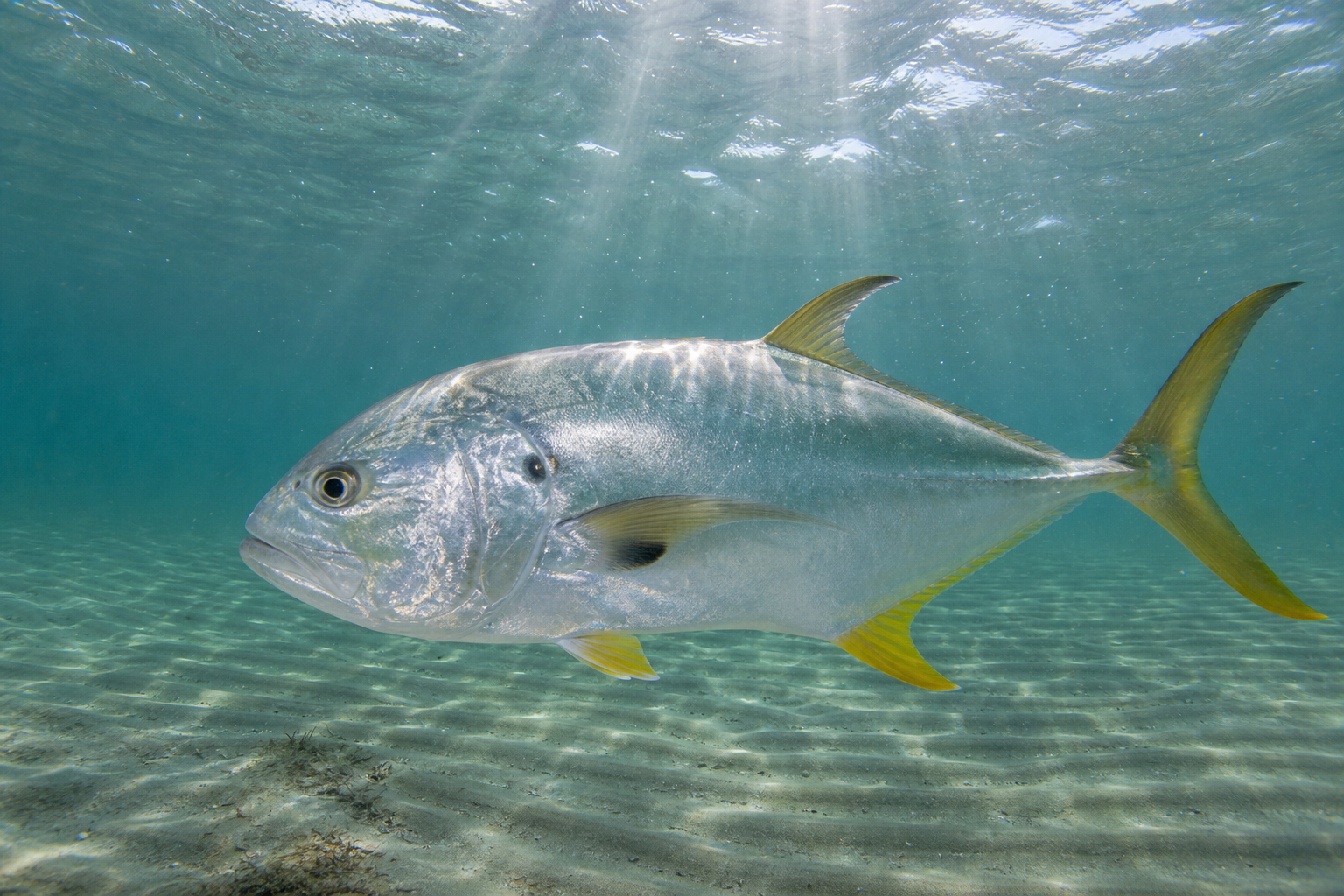
Crevalle Jack
Identification
Crevalle jacks are a powerful, broad-shouldered member of the jack family that frequent OBX waters during summer. They typically run 5 to 20 pounds, with true bruisers pushing 30-40 pounds. Crevalle jacks have a deep, compressed body with a dark olive-green to blue-green back, silver to yellowish sides, and a yellowish or dusky tail. The key identifier is the prominent black spot on the lower margin of the gill cover and the black spot at the base of the pectoral fin. They have a blunt head and a very deep body profile compared to blue runners. The adipose eyelid (a flesy flap over the eye) is another identifying feature of the Caranx genus.
Habitat and Behavior
Crevalle jacks are one of the most versatile jack species, found from the surf zone and inlets to nearshore reefs and offshore wrecks off the Outer Banks. They tolerate a wide range of salinities and will push deep into sounds and estuaries. Crevalle jacks are aggressive, powerful predators that hunt in packs — they are notorious for herding baitfish into shallow water and crashing through the school. They feed on menhaden, mullet, peanut bunker, and any other baitfish they can overwhelm. Crevalle jacks are one of the hardest-fighting fish in the ocean for their size, using their broad body and powerful tail to make long, stubborn runs.
Fishing Techniques
Topwater fishing for crevalle jacks is explosive — when jacks are crashing bait on the surface, cast a popper or walking plug into the melee and work it aggressively. Crevalle jacks respond to loud, surface-commotion lures like no other fish. Pencil poppers, spook-style walking baits, and chuggers in silver, white, and chartreuse all produce violent strikes. When jacks are deeper or not showing on the surface, swim jigs and bucktails worked through the water column are effective. Live bait fishing with live menhaden or mullet on a fish-finder rig or under a float is productive when fish are holding around reefs or inlets. Sight casting to cruising schools of jacks in shallow water is one of the most exciting OBX fishing experiences.
Baits and Lures
Topwater plugs are the top lure for crevalle jacks — the Yo-Zuri Hydro Popper, Zara Spook, and pencil poppers in silver/white get explosive strikes. Swimming jigs (1-3 oz) in chartreuse and white, bucktails tipped with grubs, and soft plastic swimbaits also produce. For live bait, live menhaden (bunker) is the top choice — hook them through the nose or back and let them swim freely. Live mullet, peanut bunker, and pinfish also work. Use 30-50 lb fluorocarbon leader — crevalle jacks don’t have teeth but their tail strikes and powerful runs can abrade lighter leaders. Circle hooks in 5/0-7/0 are standard for live bait.
Best Times and Locations on the OBX
Crevalle jacks are a warm-water species that appears off the Outer Banks from May through October, with peak action in July, August, and September. They are found throughout the OBX — from the beachfront and inlets to nearshore reefs and sounds. Oregon Inlet is a prime location for crevalle jacks, particularly when menhaden schools push through the inlet. Hatteras Inlet and the beachfront off Hatteras Village also produce jacks during the summer. The Pamlico Sound around Oregon Inlet holds crevalle jacks that push shallow bait against the grass lines and sandbars. Early morning and late afternoon, particularly around tide changes, are the best times to find jacks actively feeding on the surface.
Regulations
Crevalle jacks have no federal bag limit and no minimum size requirement. They are not subject to specific federal management measures in the South Atlantic. In North Carolina state waters, there are currently no specific recreational creel limits for crevalle jacks. Most OBX anglers release crevalle jacks as they are not considered good table fare — the meat is dark and strong-flavored. However, they are prized as one of the hardest-fighting inshore game fish available on the Outer Banks. Check with NCDFW for any regulation changes before your trip.