Eastern Oyster
Identification
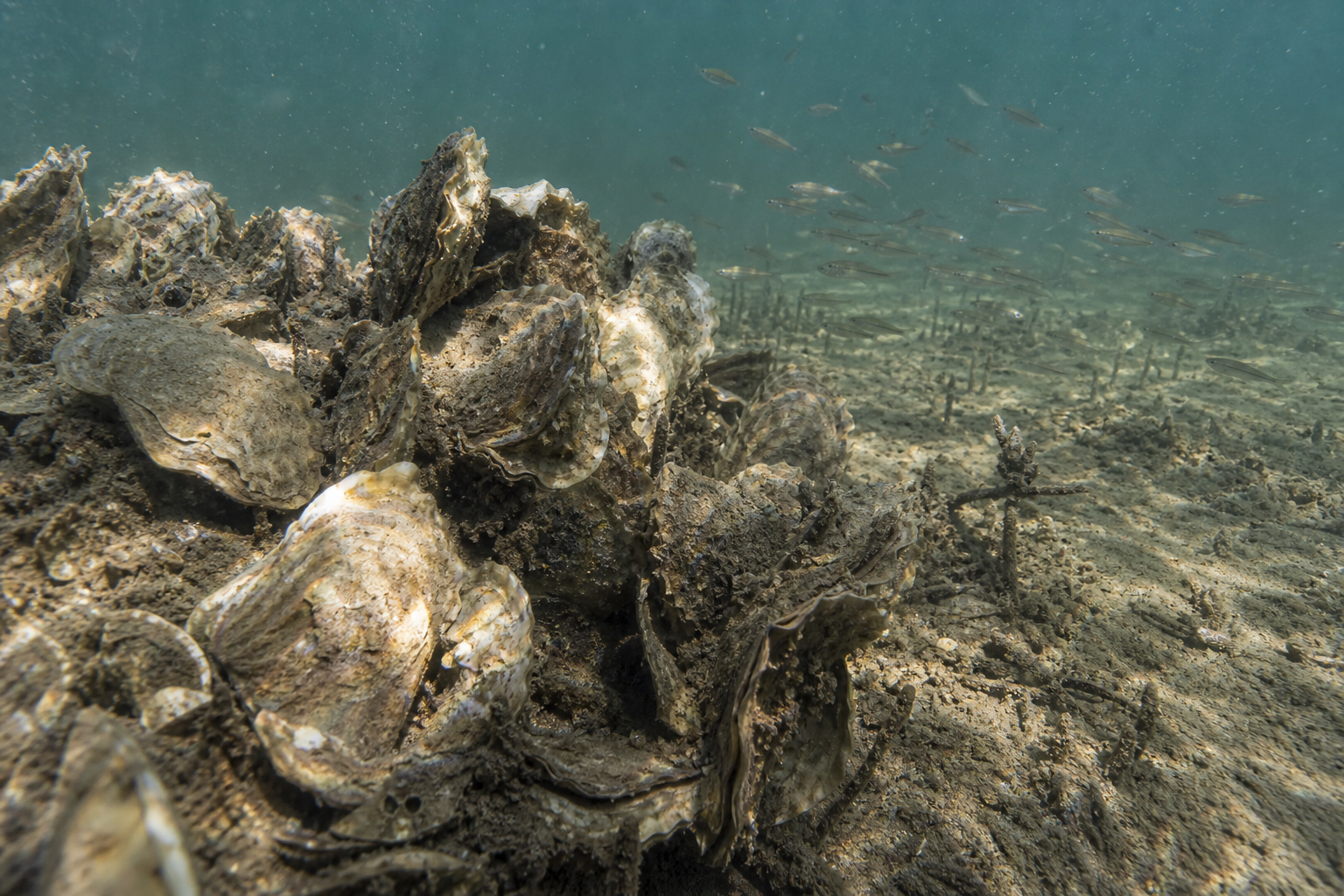
The Eastern oyster (Crassostrea virginica), also called the American oyster, is a bivalve with an irregular, elongated shell that varies from grayish-white to dark brown. The shells are rough and fluted, often clustered together in reefs. Unlike the introduced Pacific oyster, Eastern oysters are elongated rather than round. They range from 2–8 inches in length. A live oyster has tightly closed shells; gaping shells indicate a dead or compromised animal that should not be consumed. The meat is cream-colored to light gray with a briny, mineral flavor that reflects the water quality of its harvest location.
Habitat and Behavior
Eastern oysters are sessile filter feeders — they attach to hard substrate (typically other oyster shells) and remain in place for life. They build extensive reef systems that are among the most valuable marine habitats on the East Coast. On the OBX, oyster reefs line the sound-side shores, marsh edges, and creek mouths throughout Pamlico Sound, Roanoke Sound, and the back-barrier marshes. They thrive in brackish water with salinity between 5–30 ppt. Oysters feed by filtering plankton and particles from the water, with a single adult oyster filtering up to 50 gallons per day. They tolerate exposure at low tide, making intertidal reefs accessible to hand harvesters. Oysters spawn in summer when water temperatures exceed 68°F, which is why the traditional harvest season is limited to cooler “R-months” (September through April).
Harvesting Techniques
Oyster harvesting on the OBX is straightforward but physical. The simplest method is hand-picking at low tide: walk the exposed intertidal reefs in shallow sound-side waters and pick legal-sized oysters by hand or with a short rake. Oyster tongs — long-handled rakes on a pivot — are the traditional tool for harvesting subtidal reefs from a boat or skiff. Lower the tongs to the bottom, sweep them together to grasp a cluster, and lift. Hand rakes (short-handled garden-style rakes) work on shallow exposed flats. A bushel basket or mesh bag is the standard collection container. Always bring a sturdy knife or oyster glove — oyster shells are razor-sharp. Waders or old sneakers are essential for wading in mud and shell.
Best Times and Locations on the OBX
The oyster season on the OBX runs from October 15 through March 31 in most years, aligning with the cooler months when oysters are plump and safe to eat. The sound side of the Outer Banks is where the action is — the marshes behind Hatteras, Ocracoke, and Avon have extensive intertidal reefs. The creeks around Colington, the shallows of Roanoke Sound near Manteo, and the shoreline of Pamlico Sound all hold productive reefs. Low tide is essential for hand harvesting — consult tide charts and plan to be on the flats as the tide bottoms out. Calm, mild winter days are ideal; avoid harvesting after heavy rains, which can cause temporary sanitation closures due to runoff. The area around the Baum Bridge (Wanchese) and the shoreline near Nags Head causeways have accessible reef areas.
Regulations
NC recreational oyster harvest is managed by the Division of Marine Fisheries. The recreational limit is 1 bushel per person per day, with a maximum of 2 bushels per boat regardless of the number of people aboard. No license is required for hand harvesting from public grounds (walking the flats), but a Recreational Commercial Gear License (RCGL) is needed if harvesting from a vessel using tongs or rakes. The season typically runs October 15–March 31, but areas may be closed due to water quality concerns — always check the NCDEQ shellfish sanitation map before harvesting. Harvesting from leased or private oyster grounds without permission is illegal. Oysters must measure at least 3 inches in length to be retained.