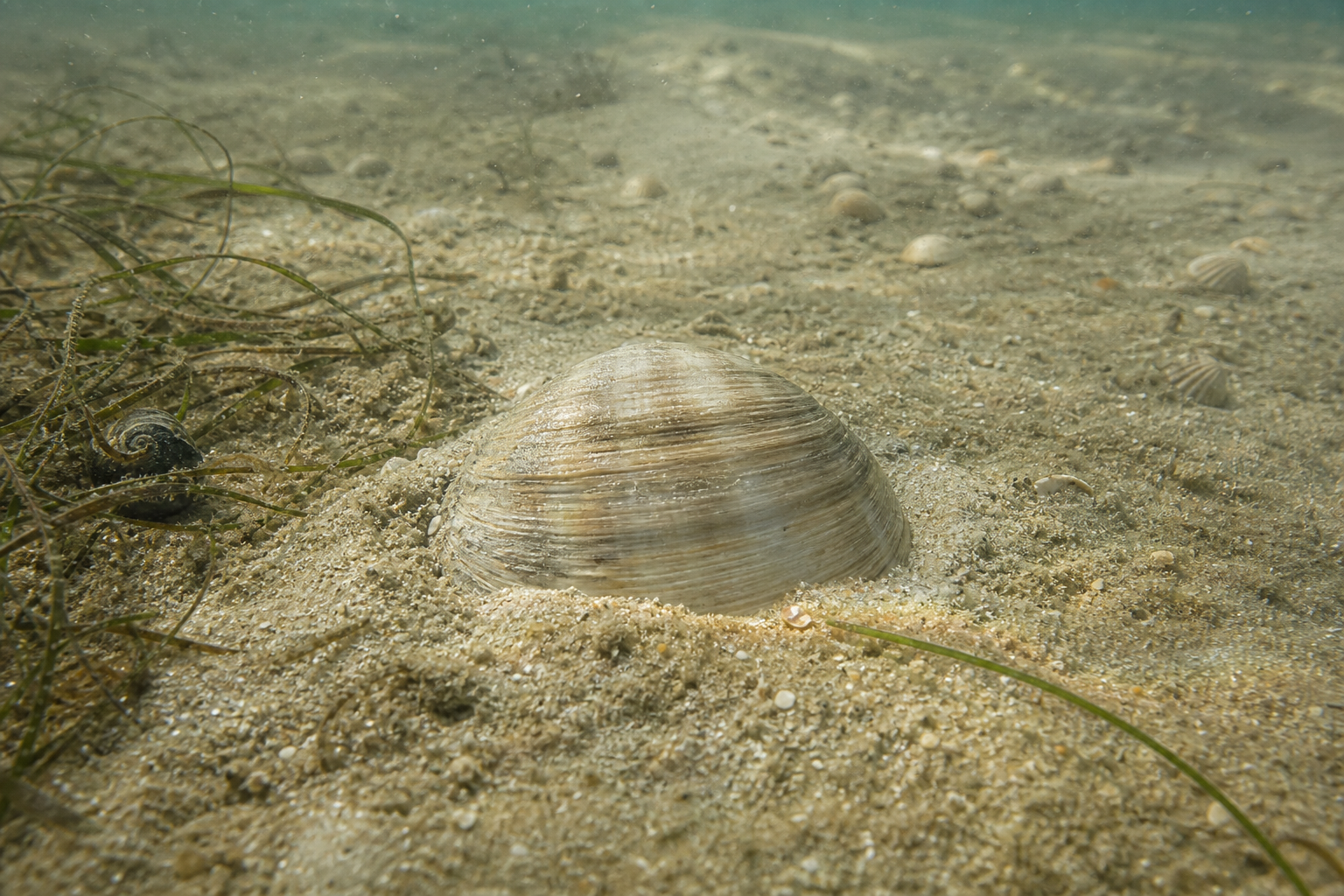
Hard Clam/Quahog
Identification
The hard clam (Mercenaria mercenaria), also known as the quahog, is a thick-shelled bivalve with a distinctive concentric ring pattern on its shell. Shell color ranges from grayish-white to tan with darker gray or brown streaks. Hard clams are categorized by size: littlenecks (1–2 inches), cherrystones (2–3 inches), and chowders (3+ inches). The meat is firm, slightly sweet, and versatile — littlenecks are prized raw on the half shell, while larger clams are used for chowder and stuffing. On the OBX, hard clams are one of the most accessible and popular shellfish for recreational harvesters.
Habitat and Behavior
Hard clams bury in sand-mud substrate in shallow estuarine waters, typically in 1–6 feet of depth. They prefer areas with moderate tidal flow and firm enough bottom to support their weight. On the OBX, they are found throughout the sound side — in Pamlico Sound shallows, Roanoke Sound grass beds, the flats behind Hatteras and Ocracoke, and in tidal creeks throughout the barrier island marshes. Clams are filter feeders that pump water through their siphons to extract plankton and organic particles. They can live 20+ years and reach sizes over 4 inches. Clams are active year-round but burrow deeper in winter, making them harder to find during cold months. They are most accessible when the water is warm and they are in the top 2–4 inches of substrate.
Harvesting Techniques
Clam raking is the most common recreational method. A short-handled clam rake (with tines spaced about 1 inch apart) is dragged or pushed through the sand-mud bottom in shallow water, and the rake catches the shell edges as it passes over buried clams. Bull rakes — long-handled rakes with a basket — are used from a boat in deeper water (4–8 feet) by reaching down to the bottom and dragging. Treading is the most primitive and satisfying method: wading barefoot in shallow water and feeling for clams with your toes, then digging them out by hand. This works best in soft sand-mud bottoms where clams are near the surface. Clam tongs, similar to oyster tongs but with a basket, work for deeper subtidal beds. Always bring a mesh bag or bucket for your catch.
Best Times and Locations on the OBX
Hard clams can be harvested year-round on the OBX, but the best season is May through October when warm water keeps clams shallow and weather allows comfortable wading. The sound-side flats behind Avon, Buxton, and Frisco are excellent clam grounds. The shallows of Roanoke Sound near Manteo and Nags Head, the grass flats of Pamlico Sound, and the tidal creeks around Ocracoke all hold strong populations. Low tide is the best time — it exposes the widest expanse of shallow flat, allowing wading and raking in knee-deep water. The area near the Washington Baum Bridge and the shallows around Colington Island are popular and productive. Warm summer evenings when the tide is low are ideal — calm water makes it easy to see clam “shows” (small holes or dimples in the sand that indicate a buried clam).
Regulations
NC recreational hard clam harvest is regulated by the Division of Marine Fisheries. The daily limit is 100 clams per person, with a maximum of 200 per boat. No license is required for hand harvesting (raking, treading) from public grounds, but a Recreational Commercial Gear License (RCGL) is required if using mechanical gear or harvesting from a vessel with tongs. Clams must measure at least 1 inch in thickness (across the hinge) to be retained. Some waters are designated as Shellfish Management Areas and may be closed to harvest due to water quality — always check the NCDEQ shellfish sanitation closure map before heading out. Harvesting from leased or private clam beds without permission is illegal.