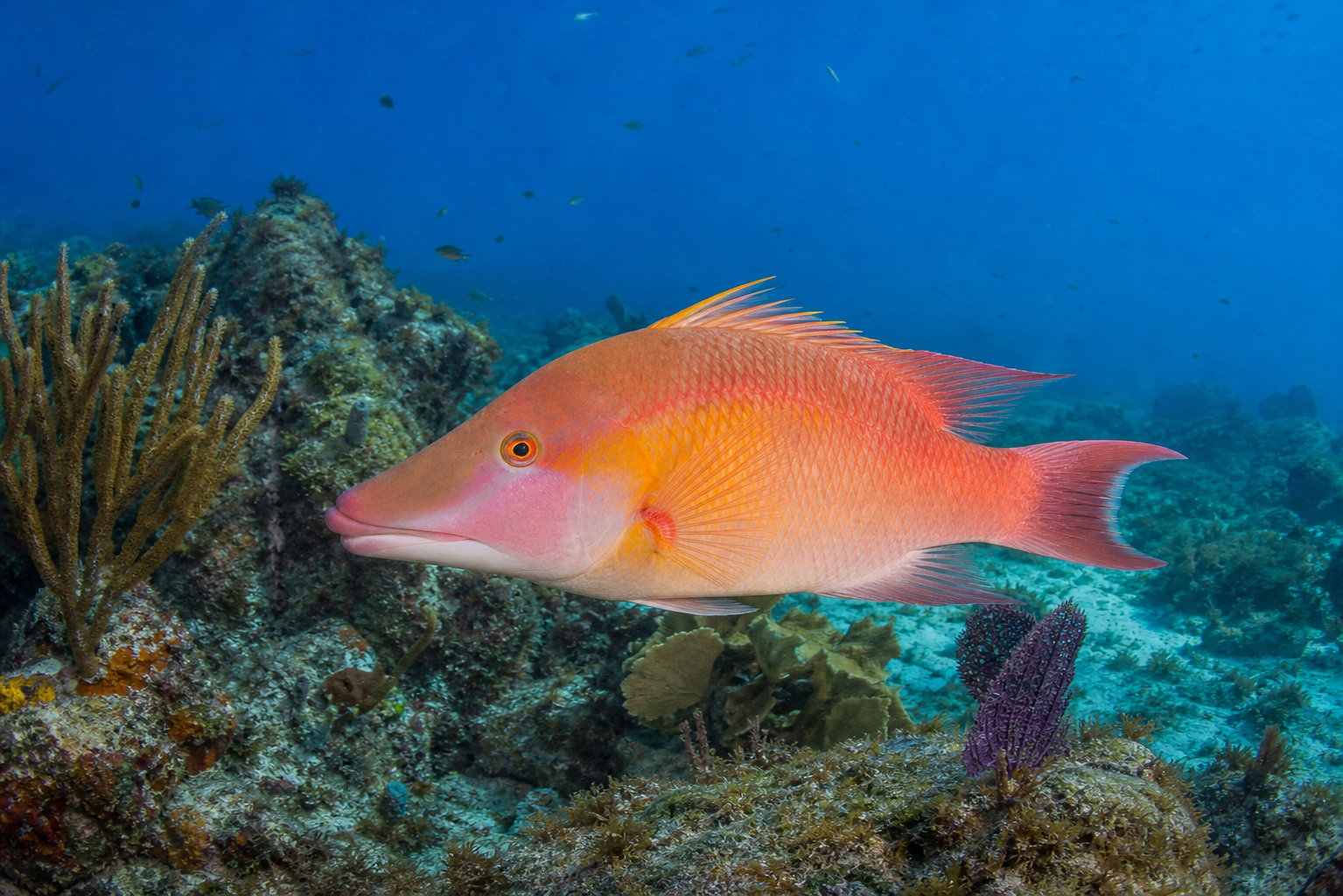
Hogfish
Identification
Hogfish — also known as hog snapper, though they are actually a member of the wrasse family (Labridae), not a true snapper — are one of the most distinctive and beautiful fish found in OBX waters. They have a deep, laterally compressed body with a coloration that can shift dramatically: generally a pearlescent white to pinkish body with a dark reddish-brown to black spot on the posterior part of the dorsal fin and along the top of the head. The most distinctive feature is the long, pig-like snout that extends forward, which they use to root in the sand for crustaceans — the source of their common name. Hogfish typically range from 12 to 24 inches and weigh 1 to 5 pounds, though they can reach much larger sizes in their core range further south.
Habitat and Behavior
Hogfish range from Nova Scotia down through Florida, throughout the Caribbean, and into the Gulf of Mexico, but they are most abundant in Florida and the Caribbean. On the OBX, hogfish are at the northern edge of their range and are considered a somewhat uncommon catch, appearing primarily in late summer when warm water pushes north. They prefer hard bottom habitats, reefs, wrecks, and areas with sponge and coral growth. Hogfish are primarily benthic feeders, using their snout to root in the sand and rubble for crabs, shrimp, mollusks, and other small invertebrates. They are diurnal feeders, most active during daylight hours. Hogfish are protogynous hermaphrodites — they begin life as females and transition to males as they grow, a fascinating biological trait.
Fishing Techniques
Hogfish are notoriously difficult to catch by hook and line because of their specialized feeding behavior — they root in the bottom for crustaceans rather than chasing prey. When they do take a bait, the bite can be extremely subtle. The standard setup is a bottom rig with a small hook (size 2 to 1/0) fished directly on hard bottom or near reef structure. Use just enough weight to hold bottom. Hogfish are often caught incidentally by anglers bottom fishing for other species on nearshore reefs and wrecks. Vertical fishing — dropping the bait straight down over structure — is the most effective presentation. Light to medium tackle (15-20 lb test) is appropriate. In the OBX, hogfish are more commonly taken by spearfishermen on nearshore wrecks and reefs than by hook-and-line anglers.
Baits and Lures
Live shrimp is the most effective natural bait for hogfish on the OBX. Small crabs, particularly fiddler crabs or small blue crabs, are also excellent. Small pieces of squid fished on the bottom near hard structure will occasionally produce hogfish. Small live fish fished near the bottom can also work. The key is using fresh, natural baits that match what hogfish are naturally rooting for — crustaceans are their primary food source. Artificial lures are generally not effective for hogfish due to their bottom-rooting feeding behavior. For spearfishing, hogfish are relatively easy to approach on reefs and are considered one of the best-eating fish in the ocean.
Best Times and Locations on the OBX
Hogfish are a warm-water species that appears on the OBX primarily in late summer, from June through October, when water temperatures are at their highest. They are not a common catch on the OBX — most hogfish are caught by boat anglers fishing nearshore artificial reefs and wrecks. The artificial reefs off Nags Head, Oregon Inlet, and Hatteras are the most likely places to encounter hogfish. They are occasionally caught from OBX piers, particularly during late summer when warm, clear water is present. Anglers bottom fishing for triggerfish, black sea bass, and other reef species are the most likely to encounter hogfish incidentally. Spearfishing on nearshore wrecks and reefs is the most reliable way to target hogfish on the OBX.
Regulations
Hogfish are managed by the NC Division of Marine Fisheries. The minimum size limit is 12 inches fork length. The recreational daily bag limit is 5 fish per person. There is no closed season in NC state waters. Federal regulations in the South Atlantic may differ — always check both state and federal regulations before fishing. Hogfish are relatively uncommon on the OBX, so any catch should be verified against current rules.