Little Tunny (False Albacore)
Identification
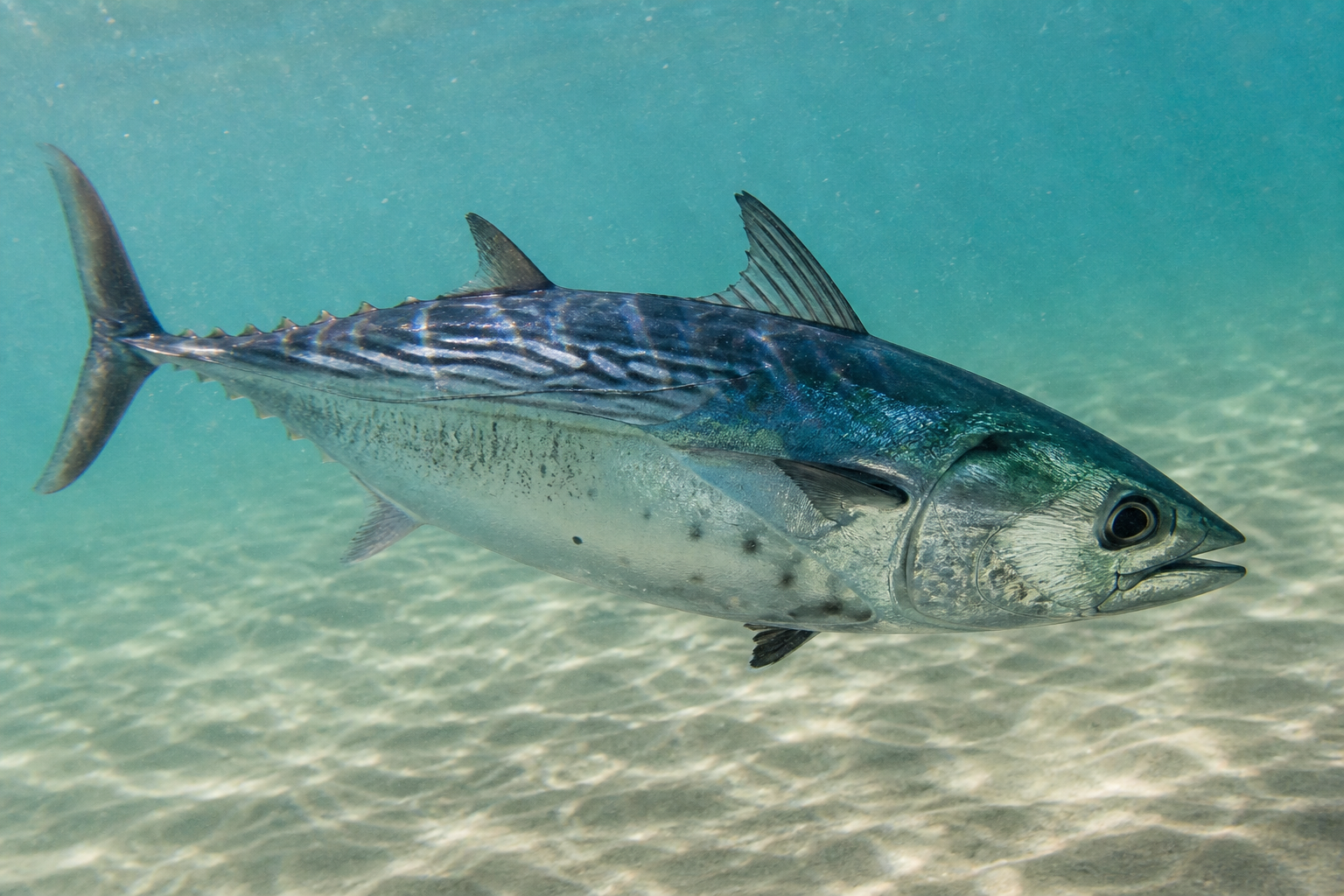
Little tunny, commonly called false albacore or “albies” on the OBX, are a small member of the mackerel/tuna family. They typically run 5 to 15 pounds, with occasional fish pushing 25 pounds. Identification is straightforward: look for dark wavy mottled lines above the lateral line (sometimes called “worm tracks” or “vermiculations”) and distinct dark spots below the pectoral fin. They have a torpedo-shaped body with a silver belly and blue-green to dark back. The wavy lines and pectoral spots separate false albacore from bonito, which have horizontal stripes and no spots.
Habitat and Behavior
False albacore are a nearshore pelagic species that arrives off the Outer Banks in impressive numbers during fall migrations. They push right up against the beach, into inlets, and over nearshore reefs and wrecks, often within a mile or two of shore. They travel in large schools and are notorious for boiling on baitfish at the surface — driving peanut bunker, bay anchovies, and silversides into tight balls. False albacore are incredibly fast and visual feeders, often leaping clear of the water while chasing bait. They are not typically eaten by anglers (dark, strong-flavored meat), but they are one of the most exciting inshore game fish on the OBX.
Fishing Techniques
Sight casting to breaking false albacore is the most thrilling method. When fish are blowing up on bait, cast small epoxy jigs, metal jigs (1/2 to 1 oz), or small soft plastics into the fray and retrieve fast. Speed is critical — albies respond to a fast, erratic retrieve that mimics fleeing baitfish. False albacore are notoriously leader-shy, so use fluorocarbon leaders in the 15-20 lb class. Fly fishing is extremely popular for false albacore — small white, olive, or chartreuse Clouser minnows and Surf Candies fished on an intermediate or floating line get explosive takes. When trolling, small Clark spoons and cedar plugs at 5-7 knots work well.
Baits and Lures
The top lures for false albacore are small epoxy jigs (1/2 oz to 1 oz in pink, white, and olive), Hogy Epoxy Minnows, and metal jigs like the AVA 007 or Kastmaster. Small soft plastic jerkbaits in pearl or silver also work when fish are finicky. For fly anglers, Surf Candy patterns, Clouser Deep Minnows in sizes 2-4, and small Deceivers in white/olive are standard. Live peanut bunker or bay anchovies fished on a small hook under a float can be deadly when fish are feeding selectively on tiny bait.
Best Times and Locations on the OBX
False albacore are a fall phenomenon on the Outer Banks. They typically show up in late August or early September and peak in October through mid-November. The best fishing is from Hatteras Inlet to Oregon Inlet, with fish pushing along the beaches from Frisco to Nags Head. Cape Point at Hatteras is legendary for false albacore — fish regularly crash bait right off the point. Oregon Inlet and the waters just south of the inlet bridge are also prime. Watch for diving birds and surface commotion within a quarter mile of the beach. Early morning and the last two hours of light produce the best surface action.
Regulations
False albacore have no federal bag limit and no minimum size requirement. They are not managed under the HMS permitting system. In North Carolina state waters, there is currently no specific recreational creel limit. Most anglers release false albacore as they are not considered good table fare. Always check with NCDMF and NOAA Fisheries for any regulation changes before your trip.