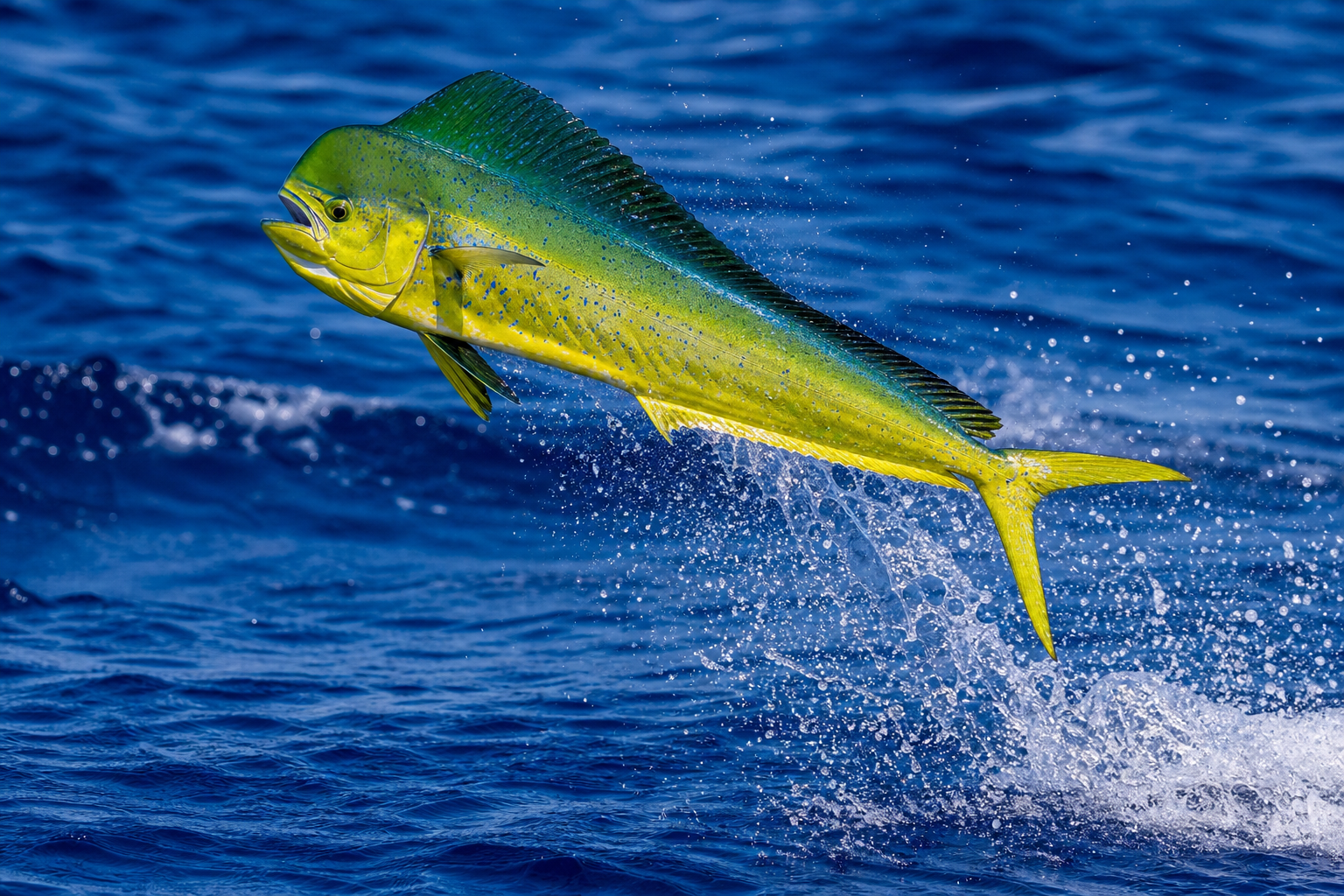
Mahi-Mahi (Coryphaena hippurus)
Mahi-mahi — also called dolphin or dorado — are one of the most colorful and exciting offshore species on the Outer Banks. Their brilliant green-and-yellow coloration, aerial acrobatics, and willingness to eat almost anything make them a favorite target of offshore anglers. Mahi are also one of the fastest-growing fish in the ocean, and their aggressive feeding makes them the perfect species for filling the cooler on a Gulf Stream trip.
Identification
Mahi-mahi have a deeply compressed body with a blunt, square-shaped head — particularly pronounced in males, or “bulls,” which develop a tall, prominent forehead. Their coloration is nothing short of spectacular: bright green and yellow on the back and sides, with iridescent blue spots scattered across the body. They have a long, sickle-shaped dorsal fin that runs the entire length of the body. Mahi-mahi display vivid color shifts when feeding or fighting — flashing electric blue, green, and yellow. On the OBX, bull mahi typically range from 10 to 30 pounds, while cow mahi run from 5 to 15 pounds. Larger bulls exceeding 40 pounds are caught every season.
Habitat and Behavior
Mahi-mahi are an epipelagic species that thrive in warm blue water and are strongly associated with Sargassum seaweed lines and floating debris. On the Outer Banks, mahi are found along the western edge of the Gulf Stream from May through September, where warm water pushes close to the shelf and carries weed lines and debris. Mahi-mahi are among the fastest-growing fish in the ocean — they can reach 15 pounds in a single year — and their populations are resilient when managed responsibly.
Mahi are aggressive sight feeders that hunt in schools around weed lines, debris, and color changes. They feed on flying fish, squid, small tunas, and any baitfish they can find. They are also known for following hooked mahi to the boat — a school of dolphin will often trail a hooked fish, providing an opportunity to catch multiple fish quickly.
Fishing Techniques
Trolling: The primary technique for mahi on the OBX is trolling rigged ballyhoo along weed lines and color changes. Run a spread of four to six lines with small skirted ballyhoo or sea witches trolled at 6–8 knots. When a mahi is hooked, leave the spread out and motor slowly to keep the school near the boat, then cast baits to the remaining fish.
Casting: When a school of mahi is spotted around a weed line or debris — or brought to the boat by a hooked fish — casting small jigs, cut bait, or live bait on spinning tackle provides fast, visual action. A 1–2 oz diamond jig or a chunk of cut bait on a casting outfit will produce instant strikes.
Baits and Lures
Ballyhoo rigged on a circle hook with a small skirt is the standard trolling bait for mahi. Pink, green, and white sea witches are classic OBX colors. Troll ballyhoo along weed lines and color changes for consistent action.
Small jigs — diamond jigs, Sting Silvers, and Gotcha jigs — are the top casting lure for mahi when you have the school near the boat. A 1 oz jig cast into the school and retrieved with a fast jerking motion will produce strikes on every cast.
Cut bait — fresh bonito, tuna, or mahi belly strips — fished on a light spinning outfit with a small hook is one of the simplest and most effective methods when the school is at the boat. Drop the cut bait into the school and let it drift — mahi will find it instantly.
Tackle Recommendations
- Rod: 6.5-foot, 30 lb class trolling rod for trolling; 7-foot medium spinning rod for casting
- Reel: Conventional reel with 30–50 lb braid for trolling; 4000–5000 size spinning reel with 20–30 lb braid for casting
- Leader: 50–80 lb fluorocarbon for trolling; 40–60 lb fluorocarbon for casting
- Hook: 7/0 circle hook for ballyhoo; 2/0–4/0 hooks for jigs and cut bait
Best Times and Locations on the OBX
Mahi-mahi season runs May through September, with peak action in June and July. Best departure points and locations include:
- Oregon Inlet Fishing Center — main fleet departure for Gulf Stream mahi trips
- Hatteras Inlet — closest access to the Gulf Stream from the southern OBX
- Gulf Stream western edge — weed lines and temperature breaks 25–40 miles offshore
- 100 fathom curve — productive area for larger bull mahi
- Sargassum weed lines — locate floating debris and weed lines for school-sized fish
Regulations
The North Carolina recreational bag limit for mahi-mahi is 10 per person per day with a minimum size of 20 inches head-to-tail length. Mahi are managed cooperatively by the South Atlantic Fishery Management Council and NOAA. While mahi populations are resilient due to their fast growth rate, bag limits and size limits are designed to ensure sustainable harvest. Always check current NC DMF regulations before your trip. Mahi are outstanding table fare — their flesh is firm, pinkish-white, and mild, with a sweet flavor that shines whether grilled, blackened, or made into tacos. Bleed and ice mahi immediately for the best quality.