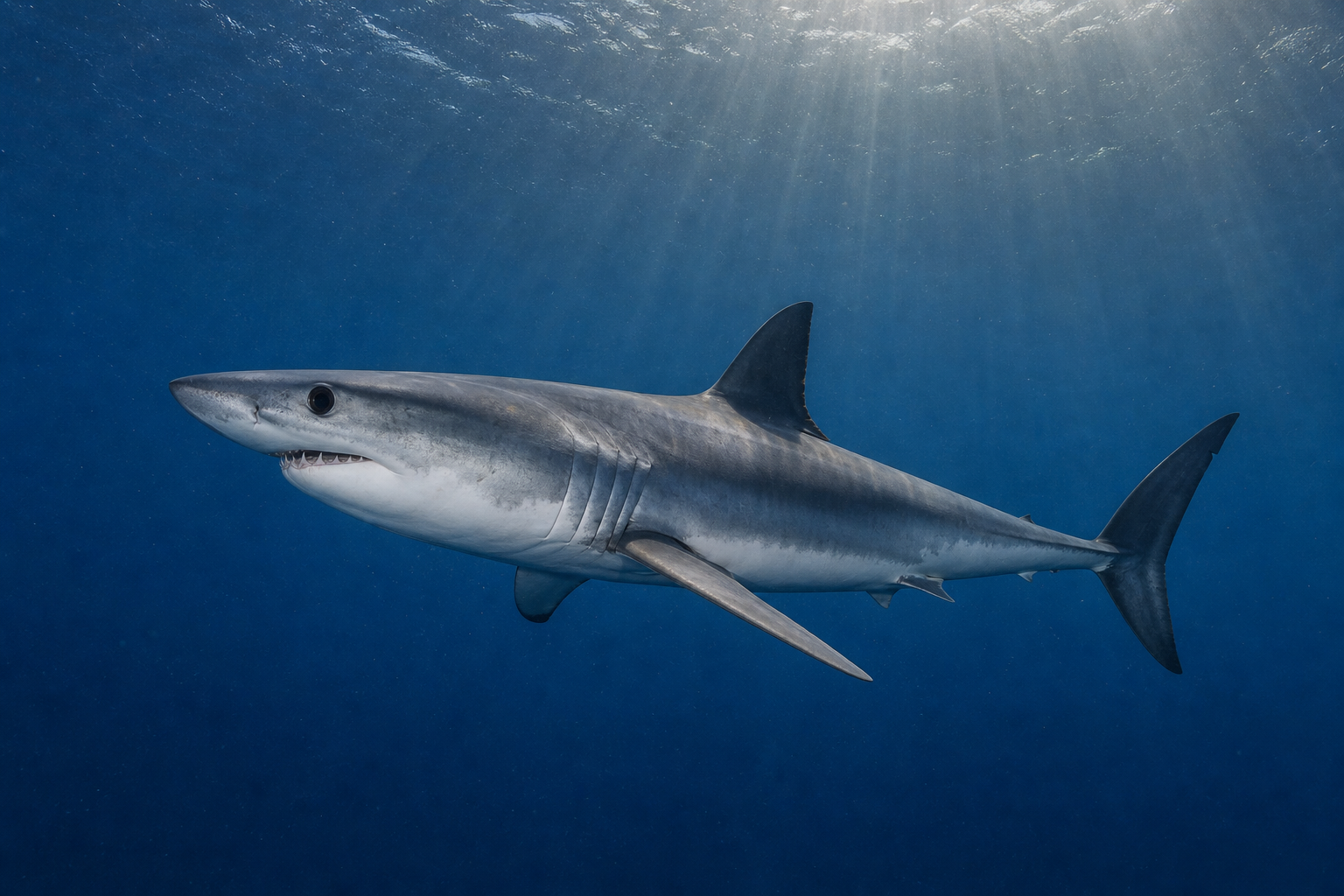
Shortfin Mako Shark
Identification
The shortfin mako is the fastest shark in the ocean and one of the most prized catches on the Outer Banks. Makos are streamlined, torpedo-shaped sharks that typically reach 8 to 12 feet in length. The body is a striking metallic blue-purple above, transitioning to bright white below. The snout is sharply pointed, and the teeth are large, smooth-edged, and visibly protruding even when the mouth is closed. The dorsal fin is relatively small and set far back, and the tail is crescent-shaped, similar to a tuna’s. Makos are often confused with the great white due to their similar body shape, but the blue coloration and protruding teeth are distinguishing features.
Habitat and Behavior
Shortfin makos are pelagic sharks that prefer the warm, blue waters of the Gulf Stream and the edges where Gulf Stream water meets cooler coastal water. On the OBX, makos are found offshore along temperature breaks, near wrecks and underwater structure, and in the blue water that sometimes pushes close to Cape Point. They are apex predators that feed on tuna, bluefish, mackerel, squid, and other pelagic fish. Makos are capable of speeds exceeding 40 mph and are known for spectacular, repeated leaps when hooked. They are solitary hunters that range widely across the open ocean.
Fishing Techniques
Mako sharks are primarily an offshore charter target on the OBX. The most effective approach is trolling or drifting live baits along temperature breaks and color changes at the Gulf Stream edge. Setting up a chum slick while drifting is a proven method for attracting makos. Use heavy conventional tackle — 50 to 80 lb class gear with 200 lb minimum wire leader. Makos have incredibly sharp teeth that cut through lighter leaders instantly. Be prepared for a blistering initial run and multiple spectacular jumps. Keep the boat in gear and follow the fish to prevent it from spooling the reel. For surf fishing, makos are extraordinarily rare but have been hooked at Cape Point when Gulf Stream water pushes close to shore.
Baits and Lures
Live baits are the most effective offering for makos. A live bluefish is the single best bait — makos actively prey on bluefish and the vibration of a live one is irresistible. Live menhaden, whole bonito, and fresh tuna chunks also produce well. When chumming, drift baits at various depths in the slick. Fresh, bloody cut bait such as tuna or bonito chunks fished on a wire leader with a 10/0 to 12/0 circle hook is standard. For trolling, rigged ballyhoo or strips of bonito trolled along temperature breaks at 5-7 knots can draw strikes. Mako baits should be substantial — these are large, aggressive predators that prefer a meaningful meal.
Best Times and Locations on the OBX
Mako sharks are present in OBX offshore waters from May through November, with peak encounters from June to September. The Gulf Stream edge off Hatteras is the primary area for mako fishing, particularly along temperature breaks and color changes. The waters off Oregon Inlet and Hatteras Inlet, near the continental shelf wrecks and reefs, are also productive. For the rare possibility of a surf-caught mako, Cape Point at Hatteras is the only realistic location, and only during periods when blue Gulf Stream water pushes close to the beach. Charter boats running out of Hatteras Inlet and Oregon Inlet have the best access to mako waters. Fish during the day, focusing on temperature breaks and clean blue water.
Regulations
Shortfin mako sharks have strict regulations due to population declines. In federal waters, recreational retention is prohibited unless the angler holds the appropriate HMS permit and the shark meets the minimum size of 71 inches fork length for males and 83 inches for females. Check current NC DMF regulations for state waters, as rules may differ. All sharks must be landed with head, tail, and fins naturally intact. Given the regulatory complexity and conservation concerns, catch and release is strongly recommended for all mako sharks. Use heavy tackle to minimize fight time, keep the shark in the water, and release quickly. Report any tagged makos to NOAA Fisheries.