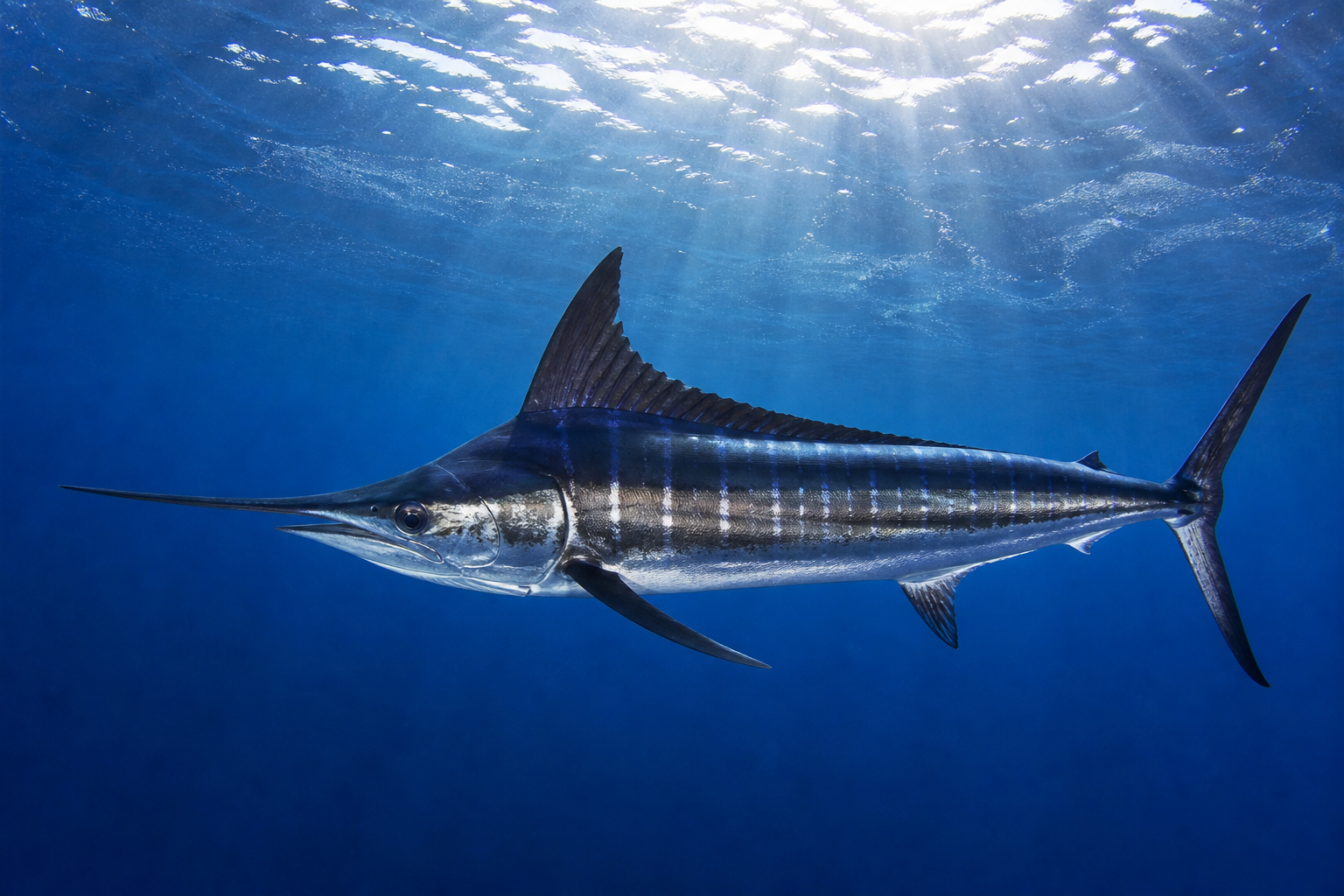
Marlin — Blue and White (Makaira nigricans / Kajikia albida)
Marlin are the top trophy on the Outer Banks offshore scene. Both blue marlin and white marlin migrate into Gulf Stream waters off the OBX every summer, drawing tournament anglers and sport fishermen from across the country. Landing a marlin — or simply seeing one in the spread — is a bucket-list experience. On the OBX, marlin fishing is primarily catch-and-release, and these fish are treated as the apex predators and trophies they are.
Identification
Blue marlin (Makaira nigricans) are massive, powerful fish with a cobalt blue back, silvery sides, and a pronounced upper jaw that extends into a spear. They have a tall, sail-like first dorsal fin and thick, rigid pectoral fins. Blue marlin on the OBX typically range from 200 to 500 pounds, but fish exceeding 800 pounds have been caught in the area. The OBX is one of the few East Coast locations where grander blue marlin — fish over 1,000 pounds — are a realistic possibility.
White marlin (Kajikia albida) are smaller and more slender than blue marlin, typically weighing 50 to 100 pounds. They are also more acrobatic, frequently launching into spectacular jumps when hooked. White marlin have a rounded dorsal fin (rather than the tall sail of the blue) and distinctive spots on their dorsal fin. They are sometimes confused with roundscale spearfish but can be distinguished by the shape of the ventral fins.
Habitat and Behavior
Both blue and white marlin are pelagic, open-ocean species that follow warm Gulf Stream water along the edge of the continental shelf. On the Outer Banks, they arrive in June as Gulf Stream water pushes onto the shelf, with the best action in July and August. Marlin follow temperature breaks, color changes, and bait concentrations — the same features that hold tuna, wahoo, and mahi, but at a higher trophic level.
Blue marlin are solitary predators that hunt tuna, mahi-mahi, squid, and other pelagic prey. White marlin are more likely to school and feed on smaller baitfish and squid. Both species are sight-oriented feeders that respond aggressively to properly presented trolling baits and lures.
Fishing Techniques
Trolling Rigged Baits: The standard OBX marlin technique is trolling rigged ballyhoo in a spread of six to eight lines at 6.5–8 knots. Blue marlin are typically targeted with large ballyhoo rigged on a heavy circle hook with a big skirt, while white marlin are targeted with smaller ballyhoo or naked ballyhoo. Run baits at varying distances — short rigger, long rigger, and shotgun — to create a spread that covers the water column.
Artificial Lures: Large skirted artificial lures trolled in the spread are the classic blue marlin technique. Use 12–16 inch skirted lures in colors like blue/silver, green/yellow, and purple/black. Artificials can be trolled faster than ballyhoo and create a bubble trail that draws marlin up from depth. Many OBX tournament boats run a combination of artificials and rigged baits.
Baits and Lures
Ballyhoo rigged on a circle hook is the standard live-dead bait for marlin. Use large ballyhoo for blue marlin and standard ballyhoo for white marlin. Skirts in colors like blue/white, purple/black, and dolphin (green/yellow) are OBX staples.
Large skirted lures — 12 to 16 inches — are the top artificial for blue marlin. Run them in the short rigger or shotgun position where they create a prominent bubble trail. Popular OBX lure colors include Joe Yee Super Plunger, Black Bart, and Mold Craft.
Tackle Recommendations
- Rod: 6.5-foot, 80–130 lb class trolling rod for blue marlin; 6.5-foot, 50–80 lb class rod for white marlin
- Reel: 80W or 130 class conventional reel for blue marlin; 50W for white marlin — spooled with 80–130 lb braid or Dacron
- Leader: 300–400 lb monofilament or fluorocarbon leader for blue marlin; 200–300 lb for white marlin
- Hook: 10/0–12/0 circle hook for blue marlin; 8/0–10/0 for white marlin
Best Times and Locations on the OBX
Marlin season on the Outer Banks runs June through September, with peak action in July and August. Best departure points and locations include:
- Oregon Inlet Fishing Center — primary departure point for the OBX marlin fleet
- Hatteras Inlet — closest access to the Gulf Stream from the southern OBX
- Gulf Stream western edge — temperature breaks and color changes 25–40 miles offshore
- 100 fathom curve and the Big Rock — ledges and drop-offs where marlin hunt
- The Point — famous temperature break near Oregon Inlet that produces blue and white marlin
Regulations
Marlin are managed under the federal Atlantic Highly Migratory Species (HMS) program. On the OBX, marlin fishing is primarily catch-and-release, but federal regulations allow retention of blue marlin 99 inches LJFL (lower jaw fork length) or larger and white marlin 66 inches LJFL or larger, with a combined vessel limit of one billfish per vessel per day. A NOAA HMS angling permit is required for the vessel, and all billfish landings must be reported to NOAA within 24 hours. The vast majority of OBX marlin are released. Always check current NOAA HMS regulations before your trip. When releasing marlin, keep the fish in the water if possible, use a dehooking tool, and revive the fish alongside the boat before release. Marlin fishing on the Outer Banks is a conservation-forward sport — treat these magnificent fish with respect.