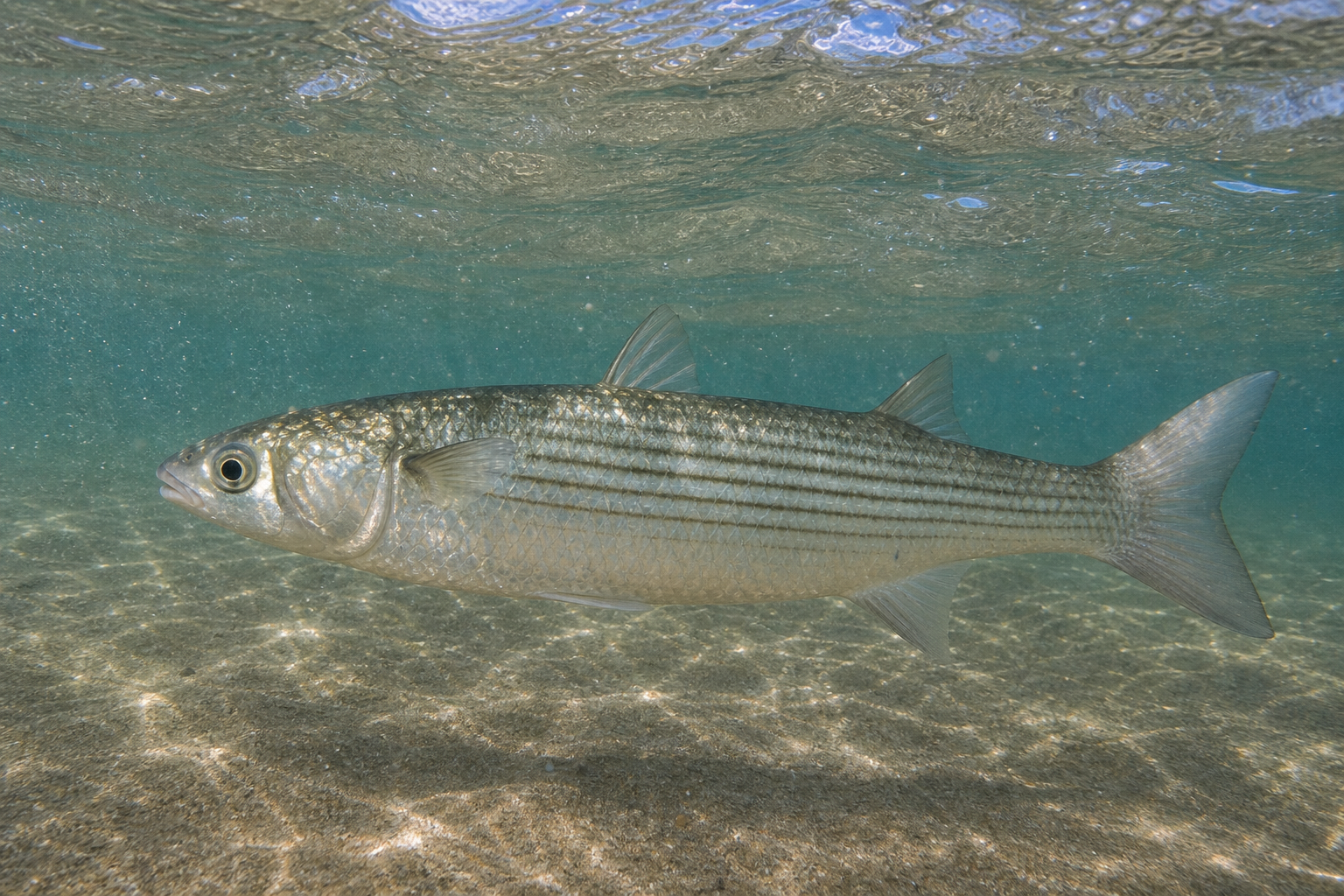
Striped Mullet
Identification
Striped mullet — also known as hardhead mullet, gray mullet, or simply “mullet” — are members of the mullet family (Mugilidae). They have an elongated, cylindrical body with a bluish-gray to olive-green back, silvery sides, and a white belly. The most distinctive feature is the series of dark horizontal stripes running along the sides, which give them their name. Striped mullet have a small, terminal mouth with no teeth (or very tiny teeth), and a flattened head with a blunt snout. They typically range from 12 to 20 inches and weigh 1 to 3 pounds on the OBX. The closely related white mullet (Mugil curema) is also present in OBX waters and is similar in appearance but lacks the distinct horizontal stripes.
Habitat and Behavior
Striped mullet are found worldwide in warm coastal waters. On the OBX, they are one of the most abundant forage fish, present in estuaries, sounds, inlets, and the surf zone. Mullet are primarily herbivorous, feeding on algae, detritus, and plant matter that they scrape from surfaces or filter from mud. They often feed at the surface, where they can be seen jumping and rolling — the famous “mullet jump.” Mullet are incredibly fast swimmers and are a primary forage species for virtually every predatory fish on the OBX, from bluefish and Spanish mackerel to red drum and cobia. In the fall, large schools of mullet migrate south along the OBX beaches, triggering some of the best fishing of the year as predators follow the mullet run.
Fishing Techniques
Catching mullet on hook and line is challenging due to their vegetarian diet and small, toothless mouths. Most mullet on the OBX are caught with cast nets for use as live bait. For hook-and-line fishing, a small hook (size 8 to 12) baited with a small dough ball made from bread, corn, or a paste of algae and flour can be effective. Float fishing these baits just below the surface near schools of mullet is the standard approach. Some anglers use a “mullet rig” — a small hook hidden inside a ball of bread dough fished on light line. The key is using very light tackle (4-8 lb test) and small, inconspicuous baits. Mullet are easily spooked, so approach schools quietly and cast ahead of the fish.
Baits and Lures
Bread dough balls are the most common bait for hook-and-line mullet fishing. Mix bread with a bit of water (and sometimes corn meal or flour) to form a dough, then form small pea-sized balls around a small hook. Corn kernels on a small hook can also work. Small bits of worm will occasionally take mullet, as will balls of algae or moss scraped from pilings. The key is small, natural baits that match what mullet are naturally eating. Artificial lures are generally not effective for mullet — they are not predatory and won’t chase lures. For cast netting, a 6-8 foot radius cast net with 3/8 inch mesh is ideal for OBX mullet.
Best Times and Locations on the OBX
Mullet are present year-round on the OBX but are most active from April through November. The fall mullet run — typically September through October — is one of the most important events in OBX fishing. Vast schools of mullet migrate south along the beaches, and the predators that follow them (bluefish, Spanish mackerel, red drum, cobia, tarpon, and more) create some of the best fishing of the year. This is why “mullet” is a magic word on the OBX in fall. For catching mullet themselves, the sounds and estuaries behind the barrier islands are the best grounds — Roanoke Sound, Pamlico Sound, and the marshes around Oregon Inlet and Hatteras Inlet all hold thick schools of mullet. Mullet can also be caught (or netted) from piers and in the surf, particularly near inlets. Early morning is best for cast netting, as mullet are often more concentrated and less wary.
Regulations
Striped mullet are managed by the NC Division of Marine Fisheries. There is no closed season and no minimum size limit for recreational anglers. The recreational bag limit is 200 fish per person per day combined with other unregulated species. Cast nets are legal in NC for catching mullet and other non-game species — check current NC DMF regulations for cast net size and mesh restrictions. Always verify current rules before fishing or cast netting.