Mussels
Identification
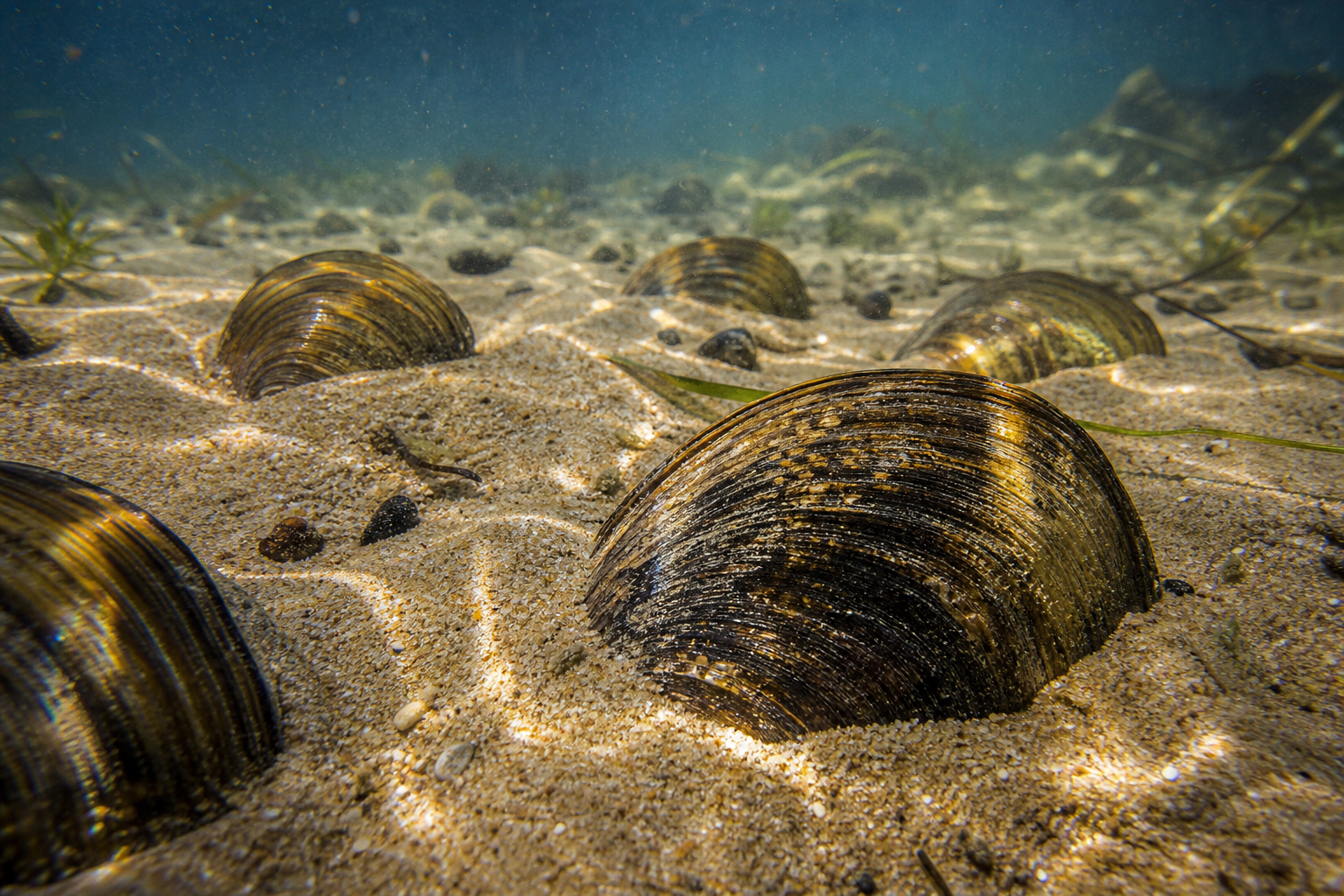
The ribbed mussel (Geukensia demissa, formerly Modiolus demissus) is the most common mussel species found in OBX estuarine waters. It has a dark brown to blackish elongated shell with distinctive radiating ribs running from the hinge to the ventral edge. Shells grow to 2–4 inches in length. Unlike the blue mussel (Mytilus edulis) found in colder northern waters, ribbed mussels are not as highly prized for eating — their meat is tougher and more strongly flavored — but they are abundant, accessible, and can be used for chowder, stuffing, or bait. Blue mussels occasionally appear in winter around inlets but are uncommon on the OBX.
Habitat and Behavior
Ribbed mussels are intertidal, living attached by strong byssal threads to the base of marsh grass stalks (especially Spartina alterniflora), oyster reef edges, and any hard structure in the estuarine shallows. They are exceptionally abundant in the marsh systems behind the Outer Banks, forming dense clusters along creek banks and marsh edges. Mussels are filter feeders, pumping water through their siphons to extract plankton and particulate organic matter. They tolerate wide salinity fluctuations and can survive extended exposure at low tide by closing their shells tightly. Their dense clusters in the marsh roots actually help stabilize the marsh bank against erosion, making them ecologically valuable. Mussels are active filter feeders during high tide and close up during low tide exposure.
Harvesting Techniques
Mussel harvesting is the simplest of all shellfish gathering on the OBX — no tools required beyond hands and a bucket. At low tide, walk the marsh edge and pick mussels directly from the base of grass stalks and exposed oyster reef edges. They detach easily with a firm twist. A short rake can help scrape clusters from marsh banks or pilings. Wear gloves — mussel shells are sharp and often encrusted with barnacles. The challenge is not catching mussels but selecting good ones: choose larger mussels (3+ inches) that are tightly closed, avoiding any with gaping or cracked shells. Clean harvested mussels by scrubbing the shells and debearding (removing the byssal threads) before cooking. Soaking in cold saltwater for 30 minutes helps them purge sand.
Best Times and Locations on the OBX
Mussels are available year-round but are best harvested from September through April (the “R-months”), the same guideline used for oysters. During summer, warm water temperatures can increase bacterial levels and make mussels less safe to eat raw. The marshes behind Hatteras, Ocracoke, and the Pea Island Wildlife Refuge have enormous ribbed mussel populations. The creeks around Oregon Inlet, the marshes of Roanoke Sound, and the back-country marshes of Pamlico Sound are all productive. Access by kayak or skiff to the marsh edges is ideal — look for the dark clusters visible on grass stalks at the waterline at low tide. Calm, mild days with a low tide are perfect for foraging. The marshes around Stumpy Point and Alligator River also hold dense mussel beds.
Regulations
Ribbed mussels are not as tightly regulated as oysters and clams in NC, but shellfish sanitation rules apply equally. There is no specific recreational bag limit for ribbed mussels in NC state waters, but harvesting from waters closed by NCDEQ shellfish sanitation is prohibited. Always check the NCDEQ shellfish sanitation closure map before harvesting — areas can be temporarily closed after rainfall due to bacterial runoff. No license is required for hand harvesting from public grounds. Mussels should only be harvested from approved waters and consumed during cooler months when water temperatures are below 70°F. Commercial sale of mussels requires a Shellfish Harvester License and harvesting from certified waters only.