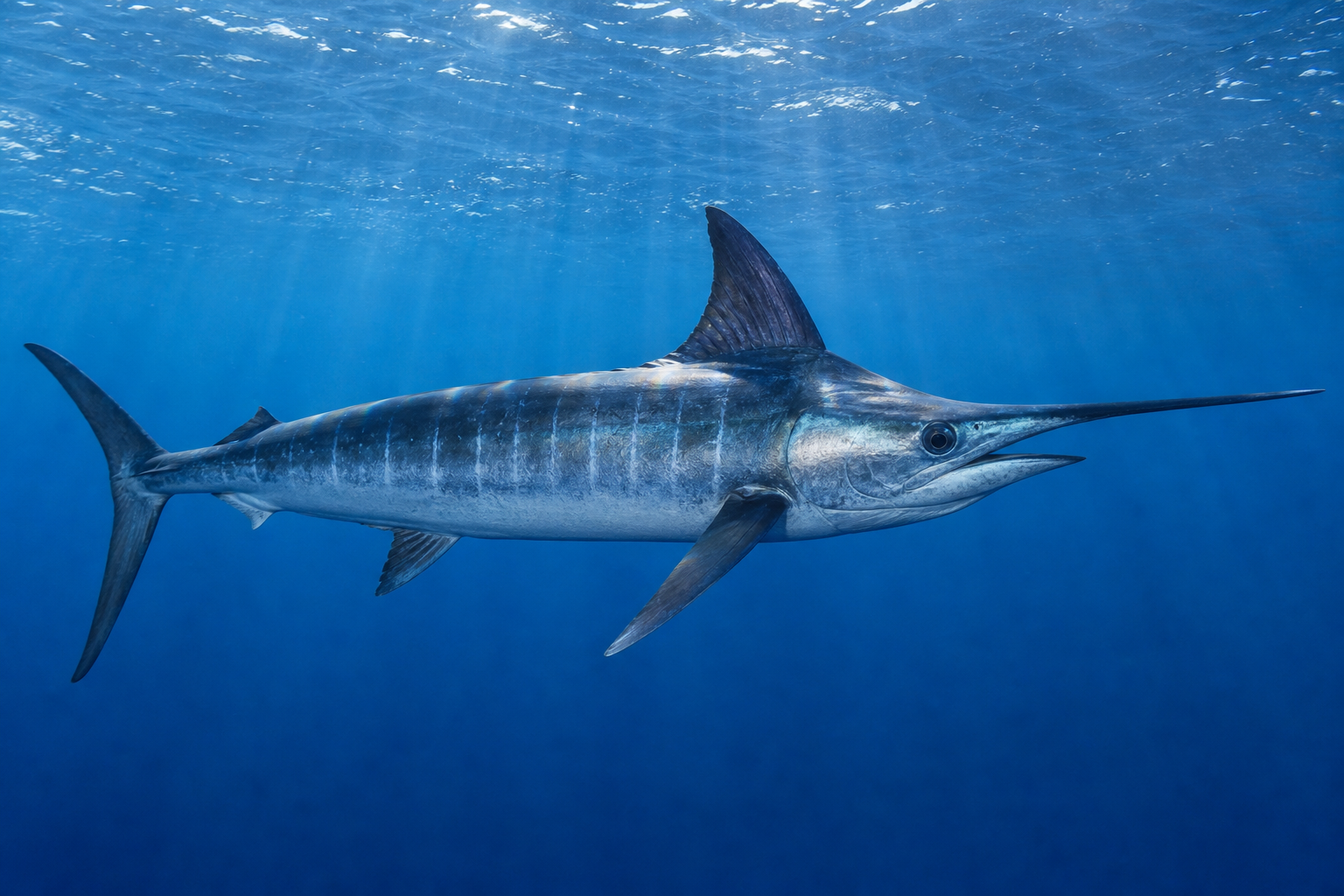
Atlantic Sailfish
Identification
Atlantic sailfish are the fastest fish in the ocean, capable of bursts exceeding 60 mph. They are characterized by their enormous, sail-like dorsal fin that runs the length of the body, a long slender bill, and a streamlined body. The back is dark blue-black with vertical stripes that light up electric blue when excited. They typically weigh 30 to 70 pounds off the OBX, with exceptional fish approaching 100 pounds. Their bill is round in cross-section, unlike the flat bill of swordfish.
Habitat and Behavior
Sailfish are surface-oriented billfish found in warm blue water (75-82°F). They are commonly found along temperature breaks and color changes where blue Gulf Stream water meets green shelf water. Sailfish hunt schooling baitfish such as ballyhoo, sardines, and flying fish near the surface. They use their sail to herd and confuse bait schools — the sail is raised to appear larger and then lowered for speed during the strike. They frequently free-jump and tail-slap at the surface, making them visible to alert anglers and captains.
Fishing Techniques
Trolling dead ballyhoo is the standard OBX sailfish technique — a natural ballyhoo rigged with a circle hook and a small skirted head, trolled at 6-7 knots along temperature breaks. Pitching live baits to surfacing sailfish is an exciting and effective alternative — when a fish is spotted free-jumping or tailing, a live sardine or menhaden is cast near the fish. Kite fishing, where a bait is suspended from a kite to keep it on the surface, is extremely effective for sailfish when they are actively feeding. Circle hooks are strongly recommended for clean releases.
Baits and Lures
Ballyhoo is the essential sailfish bait off the OBX. Rigged naked or with a small skirt (Ilander-style), ballyhoo trolled at natural speed is the most productive presentation. Live sardines, menhaden, or small blue runners are the top live-pitching baits. Skirted trolling lures in pink/white, blue/white, and blue/silver patterns trolled at higher speeds (8-9 knots) work for aggressive fish. Squid strips on small hooks work when sailfish are keyed in on small prey.
Best Times and Locations on the OBX
Sailfish are primarily a summer species off the Outer Banks, available May through October. The peak is July-August when Gulf Stream water is warmest. Fish are found in the blue water from 15-40 miles offshore from Oregon Inlet and Hatteras Inlet. The Point south of Oregon Inlet is a classic location where the current pushes bait and sailfish onto the shelf edge. Look for temperature breaks of 2-4 degrees and color changes from green to blue — sailfish patrol these edges. Floating weed lines and debris attract bait and sailfish.
Regulations
Sailfish require an Atlantic HMS recreational permit. The recreational bag limit is 1 per person per day, with a maximum of 3 per vessel per day, and a minimum size of 63 inches lower jaw fork length. Circle hooks are required when fishing with natural bait. Sailfish are catch-and-release oriented — they have low food value and high sport value. Most OBX captains release all sailfish regardless of legal harvest. Report landings to NOAA as required by HMS regulations.