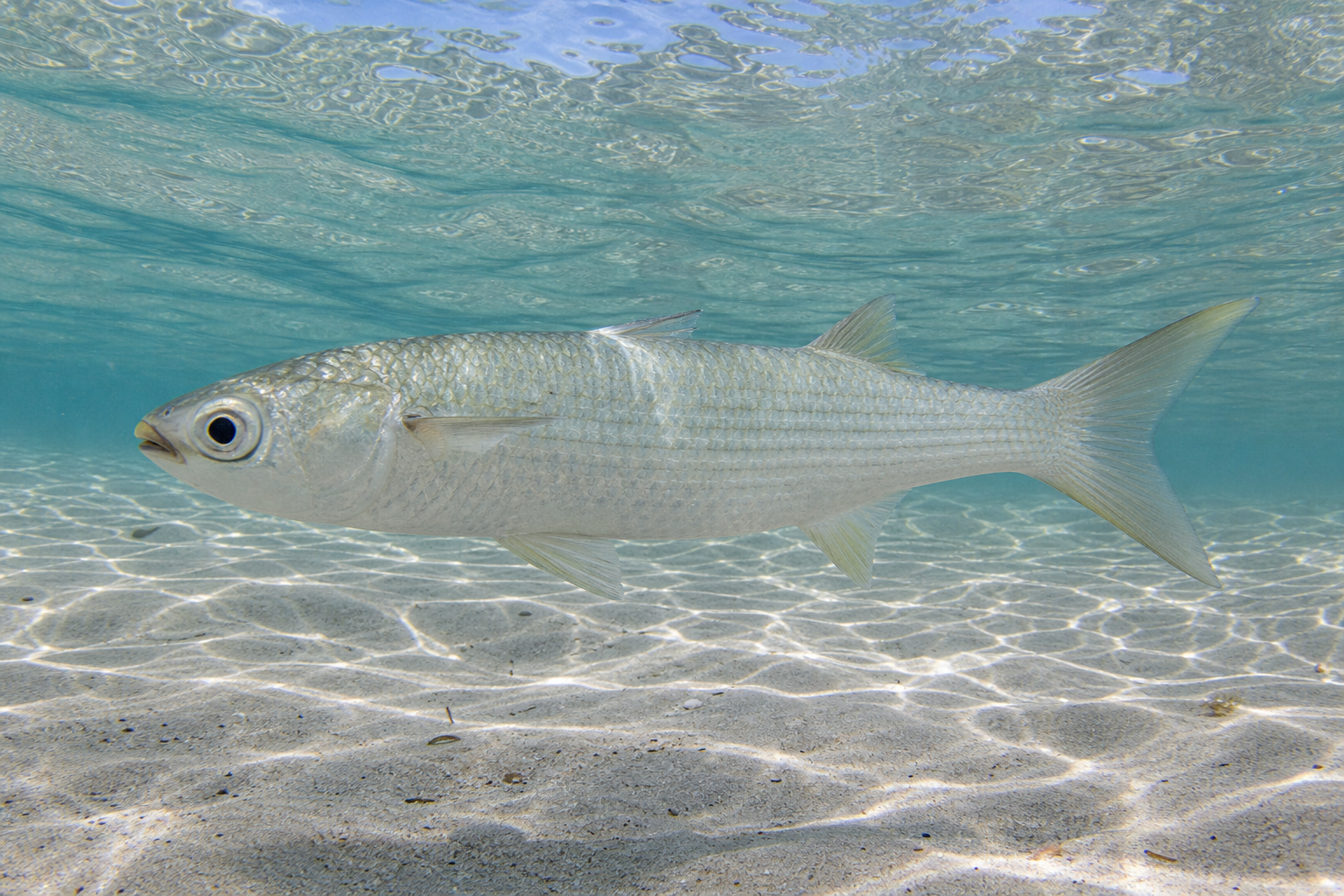
Sea Mullet
Identification
Sea mullet — also known as kingfish, whiting, or Virginia mullet — are members of the drum family (Sciaenidae). The northern kingfish (Menticirrhus saxatilis) is the most common species caught on the OBX, though the southern kingfish (Menticirrhus americanus) also appears. They have an elongated, cylindrical body with a silver-to-bronze coloration and distinctive dark vertical bars on the sides. The back is grayish-brown, and the belly is white. They have a single chin barbel (unlike the croaker’s multiple barbels) and a overhanging snout. Northern kingfish have a distinctive dark V-shaped mark behind the pectoral fin. Most OBX sea mullet run 10-16 inches and weigh up to 1-2 pounds.
Habitat and Behavior
Sea mullet range from Massachusetts to Florida and are found in the Atlantic surf zone and shallow coastal waters. They prefer sandy bottoms, particularly in the wash zone just beyond the breaking waves, where they feed on sand fleas (mole crabs), small crustaceans, and marine worms. They are bottom-oriented fish that use their barbel to sense food buried in the sand. Sea mullet are typically found in the first and second sloughs off the beach — the shallow troughs between sandbars — rather than in deep water. They move in and out with the tides, feeding aggressively in the turbulent water of the surf zone where wave action dislodges prey from the sand.
Fishing Techniques
Sea mullet are primarily a surf fish, though they are also caught from OBX piers. The classic setup is a bottom rig with one or two hooks (size 4 to 1) and a pyramid or bank sinker heavy enough to hold in the surf — typically 2 to 4 ounces. Pompano rigs (a two-hook rig with bright floats above the hooks) are also very effective for sea mullet and help keep baits above the crabs. Cast just past the breakers into the sloughs where the water is churning. Smaller surf rods in the 7-9 foot range are ideal for sea mullet fishing, as they allow precise placement of baits in the nearshore troughs. Keep the rod in a sand spike and watch the tip — sea mullet bites are often subtle taps rather than aggressive strikes.
Baits and Lures
Sand fleas (mole crabs) are the absolute best bait for sea mullet on the OBX. These small crustaceans live in the wash zone and can be caught by scooping sand in the swash zone with a sand flea rake or your hands. Fresh sand fleas outfish everything else for sea mullet. When sand fleas aren’t available, bloodworms, fresh shrimp, and squid strips all produce. Fish Bites (crab or shrimp flavor) can also work. The key is keeping the bait on or very near the bottom where sea mullet are feeding. Small pieces of bait on small hooks are most effective.
Best Times and Locations on the OBX
Sea mullet are one of the first fish to show up in OBX surf in the spring, typically appearing in April and remaining through November. May-June and September-October are peak months. The surf from Corolla to Hatteras Island all produces sea mullet, but the beaches around Oregon Inlet, Pea Island, and Cape Hatteras are particularly productive. Any beach with visible sandbars and sloughs (the troughs between bars) can hold sea mullet. The falling tide and the first part of the incoming tide tend to be most productive, as wave action churns up sand fleas and other prey. Early morning and evening are prime feeding times. OBX piers also produce sea mullet, especially during the spring when the first runs of fish move through.
Regulations
Sea mullet (kingfish) are managed by the NC Division of Marine Fisheries. There is no closed season and no minimum size limit for recreational anglers. The daily bag limit is 50 fish per person combined with other unregulated species. Always check current NC DMF regulations, as rules can be updated.