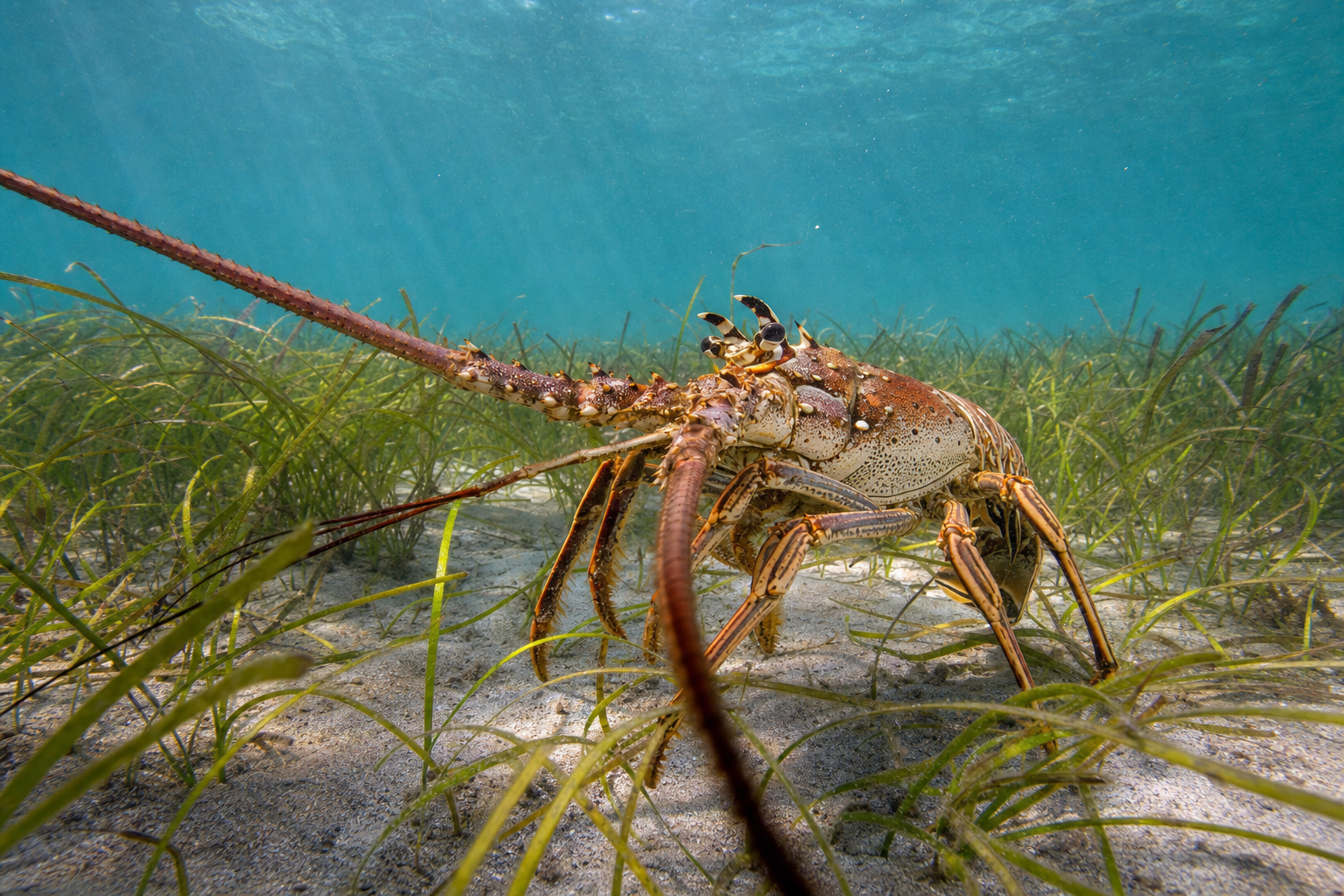
Caribbean Spiny Lobster
Identification
The Caribbean spiny lobster (Panulirus argus) is a large, clawless lobster with a hard, spiny exoskeleton ranging in color from olive-green to reddish-brown with pale yellow spots on the carapace and tail. It has two large, forward-pointing spiny antennae and no claws, unlike the American lobster (Homarus americanus). Adults can reach 15–20 inches in total length and weigh several pounds. The tail meat is the primary food product — firm, sweet, and slightly less rich than clawed lobster meat. On the OBX, spiny lobsters are at the extreme northern edge of their range and encounters are rare, making them an exciting and unexpected catch.
Habitat and Behavior
Spiny lobsters inhabit tropical and subtropical waters from the Caribbean to Florida, and occasionally stray northward to the Outer Banks via the Gulf Stream. They prefer hard-bottom habitat — coral reefs, rocky ledges, wrecks, and artificial reefs — where they shelter in crevices during the day and emerge at night to forage on snails, crabs, and urchins. On the OBX, any spiny lobster encounter would likely occur on the nearshore hard-bottom reefs and wrecks in the Gulf Stream influence zone, typically 15–40 miles offshore. Water temperature is the key limiting factor — spiny lobsters require warm water (above 68°F) and cannot survive prolonged cold exposure, which is why they are absent from OBX waters in winter and rare even in summer. They are nocturnal and highly social, often clustering in groups within crevices.
Harvesting Techniques
Spiny lobster harvesting on the OBX is essentially a diving proposition, since the lobsters are found on offshore hard bottom accessible only by boat and scuba gear. The primary method is the lobster snare or loop — a pole with a noose on the end that is slipped over the lobster’s tail while it is in a crevice, then tightened to capture it. Bully netting, common in Florida and the Keys, involves using a large hoop net on a long pole to scoop lobsters from shallow reefs at night — this is impractical on the OBX where lobsters are deep and rare. Hand-catching by diving is possible but requires skill — spiny lobsters are fast and will flick their powerful tail to retreat into crevices. A “tickle stick” is used to gently coax the lobster out of its hole before snaring. Traps are used commercially in Florida but are not a typical method in NC waters.
Best Times and Locations on the OBX
Spiny lobster encounters on the OBX are rare and unpredictable, occurring primarily in late summer to early fall (August–October) when Gulf Stream water pushes warm eddies over the nearshore reefs. The offshore wrecks and artificial reefs east of Hatteras and Ocracoke are the most likely locations — the Atlas wreck, the U-85 area, and the various artificial reef sites in 60–120 feet of water. The hard-bottom ledge systems along the 30-fathom curve can hold occasional individuals. Divers spearfishing or exploring these wrecks for other species may encounter a spiny lobster opportunistically. These encounters are so uncommon that targeting spiny lobster specifically on the OBX is not practical — it is more of a “catch of opportunity” while diving for other species. Any such catch should be considered exceptional.
Regulations
Spiny lobster is not a managed recreational species in NC in the way it is in Florida, where a defined two-day sport season and regular season (August 6–March 31) exist with a 6-per-person bag limit and 3-inch carapace minimum. In NC, because the species is rare, there is no established recreational season or bag limit specifically for spiny lobster. However, general NC fishing regulations and potentially federal fisheries rules (South Atlantic Fishery Management Council) may apply to offshore catches. If a spiny lobster is encountered and retained on the OBX, the harvester should verify current regulations with NCDEQ and the SAFMC beforehand. Given the rarity of this species on the OBX, retention should be considered carefully, and catch-and-release may be the more appropriate choice for this range-edge encounter.