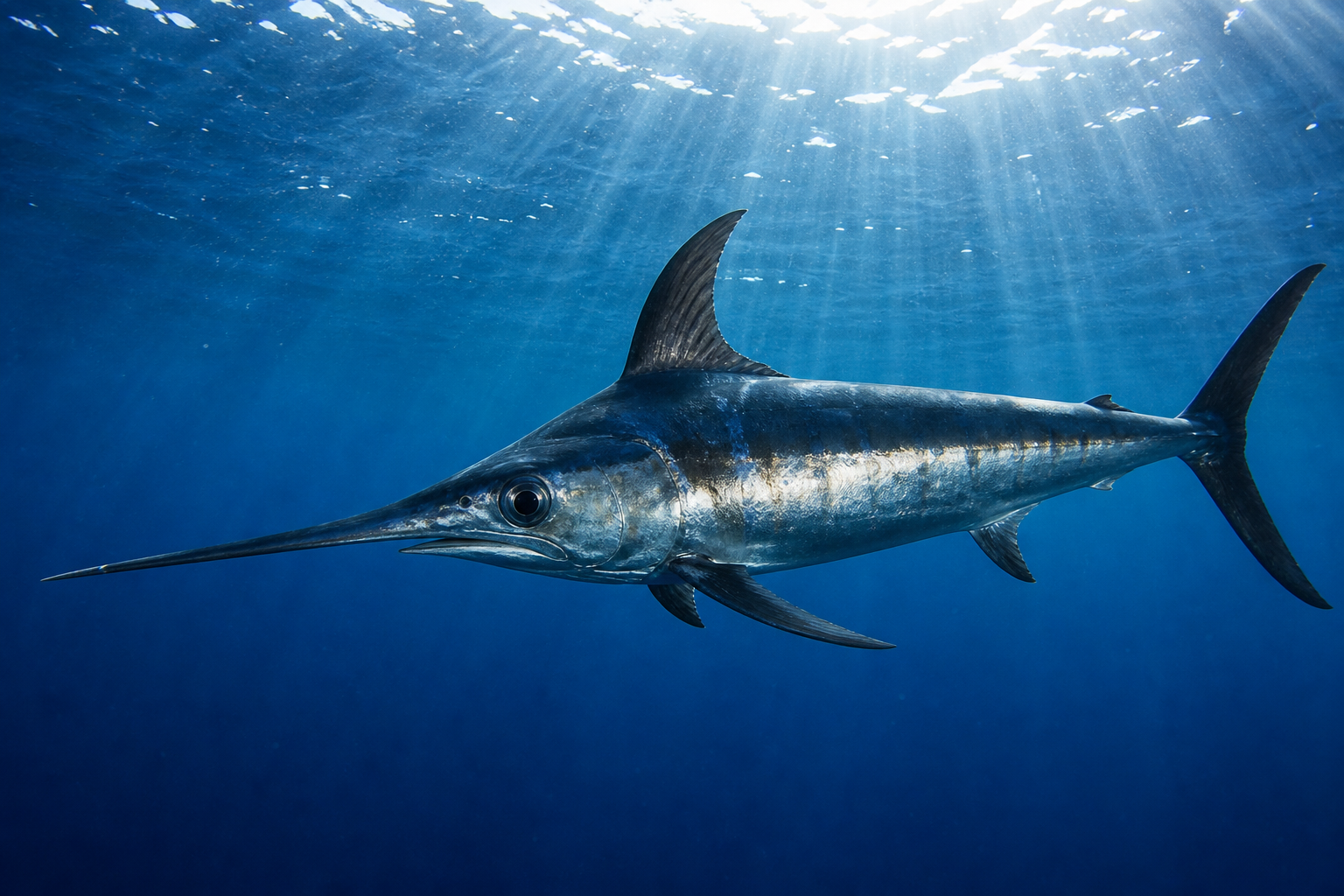
Swordfish
Identification
Swordfish have a distinctive flat, sword-like bill (unlike the round bill of other billfish), a large eye adapted for deep-water hunting, and a robust body. The back is dark brown to black, fading to a lighter brown on the sides. They lack pelvic fins and adult fish have no scales. Off the OBX, swordfish typically run 50 to 200 pounds, though fish over 300 pounds are caught each season. Their large eyes allow them to see prey in near-total darkness at extreme depths.
Habitat and Behavior
Swordfish are a deep-water species that spend daylight hours at depths of 1,000 to 3,000 feet, following the deep scattering layer of squid and fish. At night, they rise to the surface to feed, often in water as shallow as 100 feet. They prefer water temperatures of 60-75°F but tolerate extreme cold at depth. Off the Outer Banks, they associate with the deep water along the shelf edge and in the canyons. Swordfish use their bill to slash at prey, stunning squid and fish before circling back to consume them. They are solitary hunters, not school fish, though multiple fish may feed in the same area.
Fishing Techniques
Daytime deep-dropping changed OBX swordfishing. Using electric reels (or heavy hand-crank gear), anglers drop baited rigs to 600-2,000 feet during daylight hours. A typical rig uses a lead weight of 5-15 pounds at the bottom, with a single or double-hook leader above. A light stick or LED is attached near the bait for visibility in the dark depths. Nighttime fishing is the traditional approach — drifting squid baits near the surface while the boat drifts over the shelf edge. Swordfish buoy gear (a weighted line attached to a buoy) allows fishing multiple locations simultaneously.
Baits and Lures
Whole large squid are the premier swordfish bait, both for day and night fishing. Rigged on heavy circle hooks, squid is the natural prey of swordfish and produces consistent strikes. Large bonito strips, mahi-mahi belly, and mackerel are also effective. For daytime deep-dropping, the bait must be fresh and properly rigged to withstand the long descent. Glow beads, light sticks, and luminescent skirts are added to the rig to attract attention in the dark depths.
Best Times and Locations on the OBX
Daytime swordfish are available year-round in deep water, but the most consistent action is May through October when calmer conditions allow long offshore runs. Nighttime swordfishing peaks in summer. Target water from 30-50 miles offshore from Oregon Inlet, along the shelf edge in 100+ fathoms. The Point and the canyons to the northeast are prime locations. Look for deep-water structure — underwater canyons, seamounts, and steep dropoffs concentrate swordfish prey.
Regulations
Swordfish require an Atlantic HMS recreational permit. The recreational bag limit is 1 per person per day, maximum 3 per vessel per day, with a minimum size of 47 inches lower jaw fork length. Circle hooks are required when using natural bait. The commercial swordfish fishery is quota-managed with longline permits. Recreational landings must be reported through the HMS reporting system.