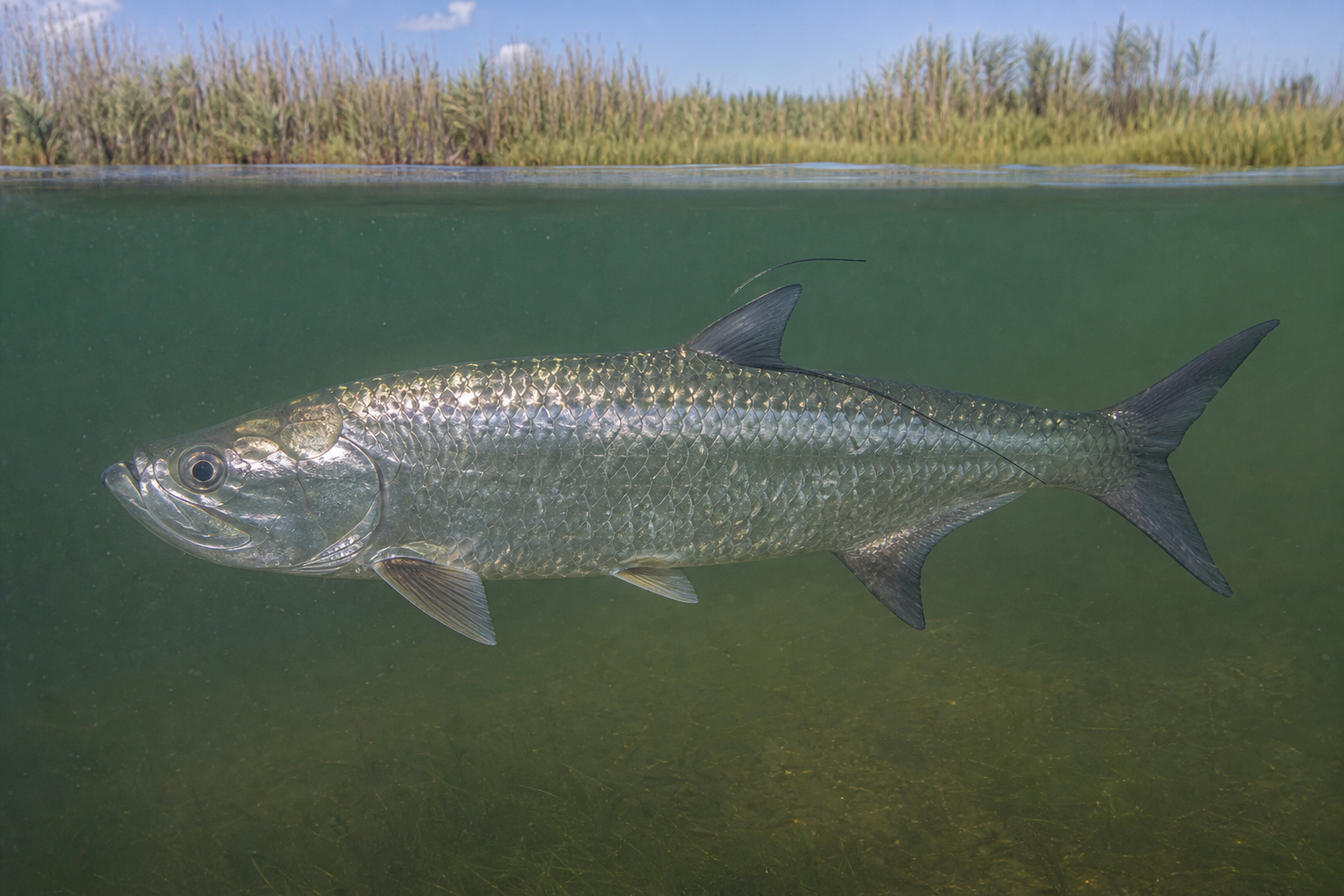
Tarpon
Identification
Tarpon are one of the most iconic and powerful game fish found in North Carolina’s outer waters. These silver giants are unmistakable — large, slab-sided fish with enormous, mirror-like scales, a wide upward-facing mouth, and a distinctive dorsal fin that trails into a long filament. Their coloring is dark blue to greenish-black on the back, transitioning to bright silver on the sides and belly. Tarpon can grow to massive proportions, with OBX specimens commonly ranging from 40 to over 150 pounds. The last ray of the dorsal fin is elongated, and their large eyes give them a prehistoric look. They are known for their explosive jumps when hooked, often clearing the water by several feet.
Habitat and Behavior
Tarpon are a warm-water species that migrate northward along the Atlantic coast during summer. On the Outer Banks, they typically arrive in June and remain through early October, with the peak occurring in July and August. They prefer warm, brackish to saltwater environments and are most commonly found in the deeper waters of Pamlico Sound, particularly around Oregon Inlet and Hatteras Inlet. Tarpon are known to congregate in deep holes, channel edges, and around the mouths of inlets where tidal currents concentrate baitfish. They are obligate air breathers, meaning they can gulp air at the surface using their modified swim bladder, which allows them to survive in oxygen-poor water where other fish cannot. This behavior makes them easy to spot rolling on the surface, especially in calm, early morning conditions.
Fishing Techniques
Tarpon fishing on the OBX is primarily a live bait game. The most effective approach is to anchor or slow-drift near the inlet mouths, channel edges, or known deep holes in Pamlico Sound, and present live bait on the bottom or suspended just above it. Circle hooks are essential for ethical catch and release, as tarpon have hard, bony mouths that make hook-setting difficult. Use heavy tackle — a 7 to 9-foot heavy action rod paired with a large spinning or conventional reel spooled with 50 to 80-pound braided line and a long 80 to 100-pound fluorocarbon or monofilament leader. Sight casting to rolling fish is also productive when conditions allow. Patience is key — tarpon can be finicky and may require hours of waiting before a strike.
Baits and Lures
Live bait is by far the most productive offering for OBX tarpon. Live mullet in the 6 to 10-inch range are the top choice, followed by live menhaden (bunker) and small bluefish. Live crabs, particularly blue crabs, are also effective when fished on the bottom. Pinfish and croaker can work as well. When presenting live bait, use a sliding sinker rig or a fish-finder rig with enough weight to hold bottom in the strong tidal currents of the inlets. Artificial lures are less commonly used for tarpon in the sound, but large swimbaits and jigging spoons can occasionally entice strikes from actively feeding fish.
Best Times and Locations on the OBX
The tarpon fishery on the Outer Banks is concentrated in Pamlico Sound, with the most productive areas being around Oregon Inlet and Hatteras Inlet. The waters behind Hatteras Island, particularly the deep channels and sloughs, are prime tarpon territory. The best time of year is July through September when water temperatures in the sound reach the mid-70s to low 80s. Early morning and late afternoon, especially around tide changes, are the most productive times. Calm days make it easier to spot rolling fish. The area around the Bonner Bridge and the inlet throat at Oregon Inlet is a well-known tarpon hotspot, as is the Hatteras Inlet bar and the deep water on the backside of the inlet.
Regulations
Tarpon are not classified as a game fish in North Carolina, meaning there is no closed season, size limit, or bag limit in state waters. However, catch and release is strongly encouraged by virtually all OBX anglers and charter captains, as tarpon are slow-growing and the population is fragile. If you do harvest a tarpon, it must be reported. Anglers targeting tarpon should use circle hooks to reduce deep hooking, keep the fish in the water as much as possible during release, and revive the fish thoroughly before letting it go. Federal waters may have additional restrictions, so always check current NC Division of Marine Fisheries regulations before heading out.