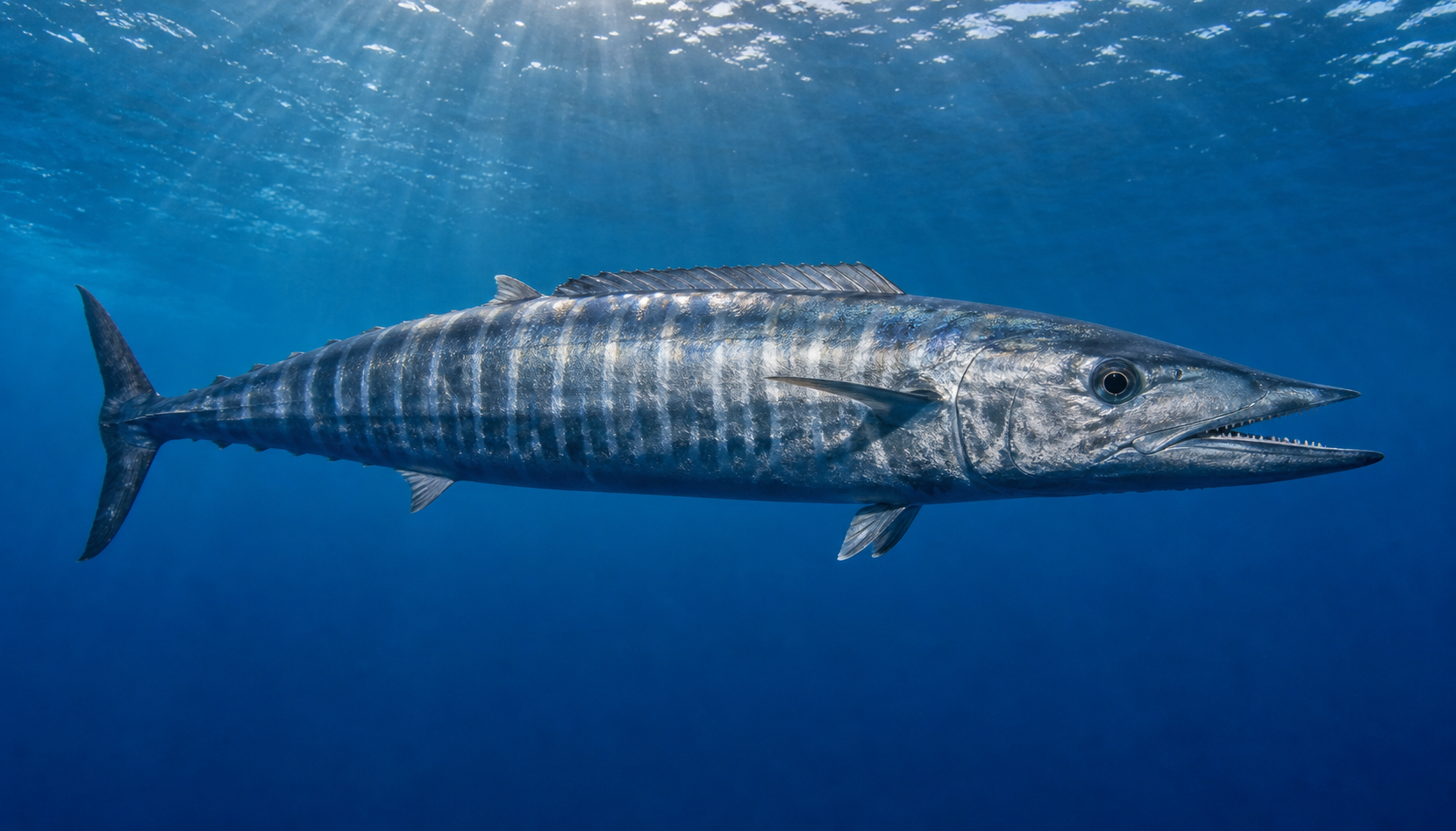
Wahoo (Acanthocybium solandri)
Wahoo are the speed demons of the Outer Banks offshore fishery. Capable of blistering runs exceeding 50 miles per hour, wahoo are one of the most exciting and prized game fish in Gulf Stream waters. They are aggressive, lightning-fast, and excellent on the table — their firm, white flesh is among the best eating of any offshore species. On the OBX, wahoo are targeted year-round but the best action comes during fall and winter when water temperatures drop and wahoo move into the edge of the Gulf Stream.
Identification
Wahoo have a long, slender, torpedo-shaped body built for speed. They are dark steel blue on the back with a silvery belly, and their most identifying feature is the series of vertical tiger stripes that extend below the lateral line. These stripes are bright and iridescent when the fish is alive, often showing electric blue. Wahoo have a very long snout filled with razor-sharp, serrated teeth and a forked tail with a slender caudal peduncle. They are sometimes confused with king mackerel but are easily distinguished by the vertical stripes and the long snout. Adults on the OBX typically range from 20 to 60 pounds, but fish exceeding 80 pounds are caught every season, and the OBX has produced wahoo over 100 pounds.
Habitat and Behavior
Wahoo are a pelagic species that prefer warm blue water along the edge of the Gulf Stream. On the Outer Banks, they are found year-round in Gulf Stream waters 25–40 miles offshore, with the best action in fall and winter when cooler water pushes wahoo onto the western edge of the Stream. Wahoo favor temperature breaks, color changes, and ledges — the same areas that hold tuna and mahi, but often at different times. They are solitary or loosely schooling predators that ambush prey at high speed, feeding on squid, flying fish, and other pelagic baitfish.
Wahoo are most active during dawn and dusk and are known for their savage strikes — they often hit lures so hard that they can snap wire or heavy monofilament leaders if the drag is set too tight. Their first run is blistering and requires a smooth, properly set drag.
Fishing Techniques
High-Speed Trolling: The signature technique for OBX wahoo is high-speed trolling — pulling lures at 12–18 knots, far faster than standard trolling speeds. This method allows anglers cover more water and trigger strikes from wahoo that are keyed in on fast-moving prey. Use weighted lures, planers, or downriggers to get baits below the surface at these speeds.
Standard Trolling: Conventional trolling at 6–9 knots with skirted ballyhoo, Rapala plugs, and Islander-ballyhoo combinations along the Gulf Stream edge is also highly productive. Run a spread with baits at varying depths — surface, mid-water, and deep — to find where the wahoo are feeding.
Baits and Lures
Ballyhoo with a skirt is the classic OBX wahoo trolling bait. Rig ballyhoo on a wire leader with a heavy-duty hook and dress it with a dark-colored skirt — purple/black, red/black, or blue/white. Add an Islander or a sea witch ahead of the bait for extra action. This combination is the standard wahoo killer on the OBX.
Rapala plugs — particularly the X-Rap Magnum in red/white, purple, or silver — are another top wahoo producer. These diving plugs can be trolled at both standard and high speeds and produce savage strikes. The diving lip gets the plug down to wahoo depth without a planer.
Laser Sharp jigs and cedar plugs trolled deep can also produce wahoo when they are holding deeper in the water column.
Tackle Recommendations
- Rod: 6–6.5-foot, 50–80 lb class trolling rod with a stiff action to handle high-speed trolling
- Reel: Conventional reel like Shimano Tiagra 30W or 50W with 50–80 lb braid and a smooth drag
- Leader: 80–130 lb wire or 150–200 lb monofilament leader — wire is recommended due to wahoo teeth
- Hook: 7/0–9/0 heavy-duty hook rigged on wire for ballyhoo; split rings for plugs
Best Times and Locations on the OBX
Wahoo are present year-round on the Outer Banks, but the best action is from October through February. Best departure points and locations include:
- Oregon Inlet Fishing Center — primary fleet for Gulf Stream wahoo trips
- Hatteras Inlet — closest access to the Gulf Stream from the southern OBX
- Gulf Stream western edge — temperature breaks and color changes 25–40 miles offshore
- 100 fathom curve — ledges and drop-offs along the Stream edge hold wahoo
- The Point — famous OBX temperature break near Oregon Inlet
Regulations
The North Carolina recreational bag limit for wahoo is 2 per person per day with no minimum size limit. Wahoo are managed cooperatively by the South Atlantic Fishery Management Council and NOAA. While wahoo populations are currently healthy, bag limits are designed to ensure sustainable harvest. Always check current NC DMF regulations before your trip. Wahoo are one of the best-eating fish in the ocean — their firm, white flesh is mild, slightly sweet, and excellent grilled, blackened, or smoked. Bleed and ice wahoo immediately for the best quality, and the belly meat is a delicacy when prepared as sashimi.