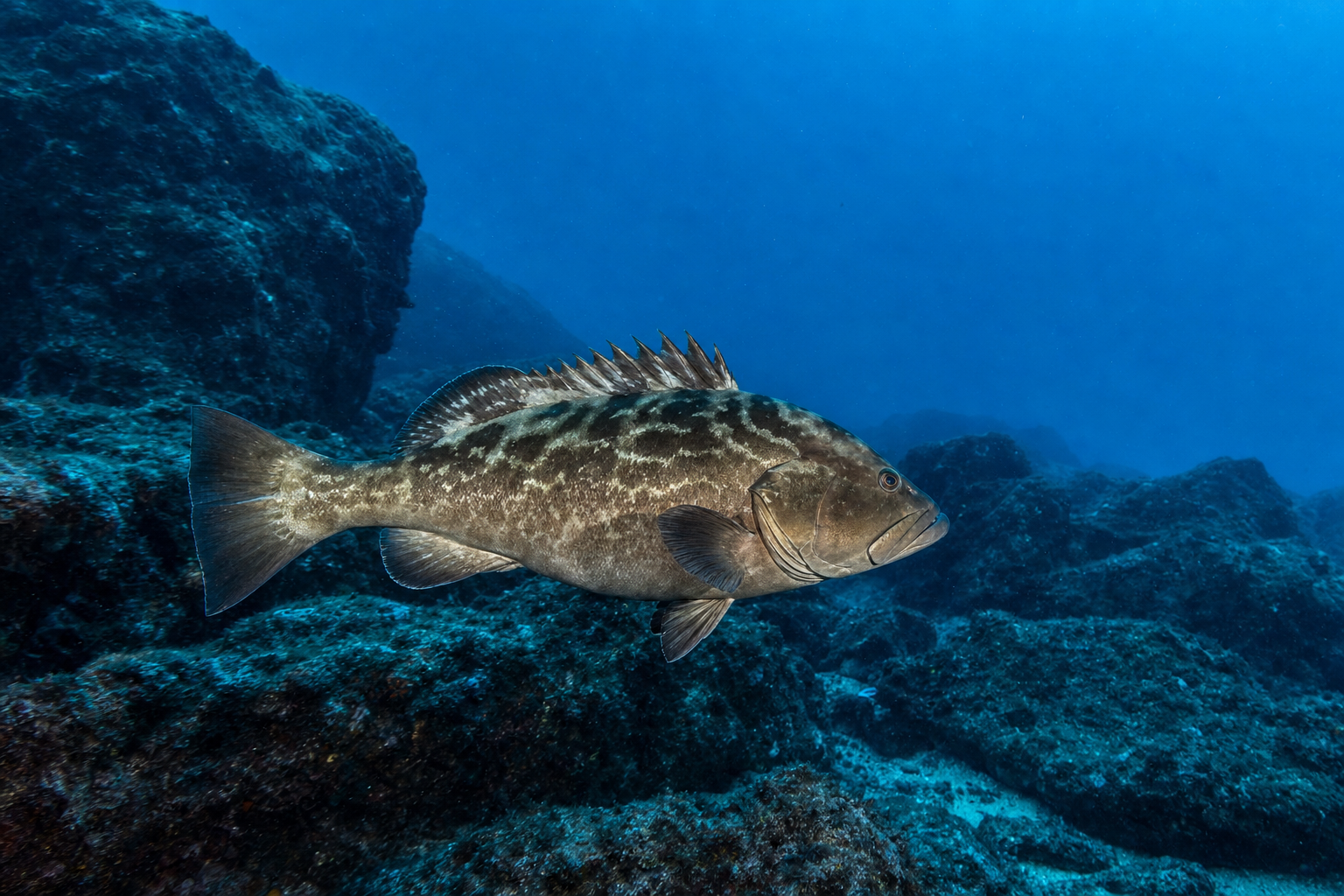
Warsaw Grouper
Identification
Warsaw grouper are one of the largest grouper species, capable of exceeding 300 pounds. They have a dark brown to almost black body, robust build, and a distinctive second dorsal spine that is noticeably longer and taller than the others, giving a raised appearance to the front of the dorsal fin. Juveniles have yellowish spots on a dark background, but adults are uniformly dark. Their large eyes reflect their deep-water habitat. Off the OBX, warsaw grouper are rare and typically encountered as incidental catches on deep-drop trips.
Habitat and Behavior
Warsaw grouper inhabit very deep water — typically 400 to 1,000 feet along the continental slope. They prefer rocky ledges, deep-water hard bottom, and large underwater structures. They are slow-growing, extremely long-lived fish that can live over 40 years. Warsaw grouper are apex predators on the deep reef, feeding on fish, squid, and large crustaceans. Because of their extreme depth and rarity, they are rarely targeted and most catches are incidental while deep-dropping for snowy grouper or tilefish.
Fishing Techniques
Deep-drop fishing with electric reels is the only practical method for warsaw grouper. Heavy electric reels (Lindgren-Pitman S-32, Daiwa Tanacom 1000) spooled with 80-130 lb braid are required. The rig is similar to snowy grouper — heavy weight (2-5 pounds), circle hooks on heavy leaders, lowered to the bottom in 400+ feet. When a warsaw hits, the fight is a long, heavy grind. Heavy butterfly jigs (400-600g) may also produce strikes if worked along the bottom.
Baits and Lures
Whole fish baits — small croaker, grunts, or large baitfish — are the top warsaw baits. Large squid and sardine chunks also work. The key is presenting a substantial bait on the bottom in extreme depth. Heavy butterfly jigs in dark color patterns (blue/black, purple) can trigger strikes from deep-water predators. Because warsaw are so rare, standard deep-drop baits for snowy grouper and tilefish are what typically produce warsaw encounters.
Best Times and Locations on the OBX
Warsaw grouper are extremely rare off the Outer Banks. They are found in the deepest accessible water — 400+ feet along the continental slope, typically 50+ miles offshore from Hatteras Inlet and Oregon Inlet. Deep-water ledges along the 100-fathom curve and steep dropoffs are the only realistic locations. Warsaw are incidental catches on deep-drop trips targeting snowy grouper, tilefish, and other deep-water species. There is no reliable “season” for warsaw — they are caught unpredictably year-round.
Regulations
Warsaw grouper are subject to strict regulations due to their vulnerability to overfishing and population decline. The South Atlantic Fishery Management Council has implemented spawning closure areas in federal waters. Possession may be prohibited or severely restricted — the minimum size, if retention is allowed, is 50 inches total length. In many cases, warsaw grouper must be released. Always check current SAFMC and NOAA Fisheries regulations before fishing. Given their protected status, catch and release is the expected practice.