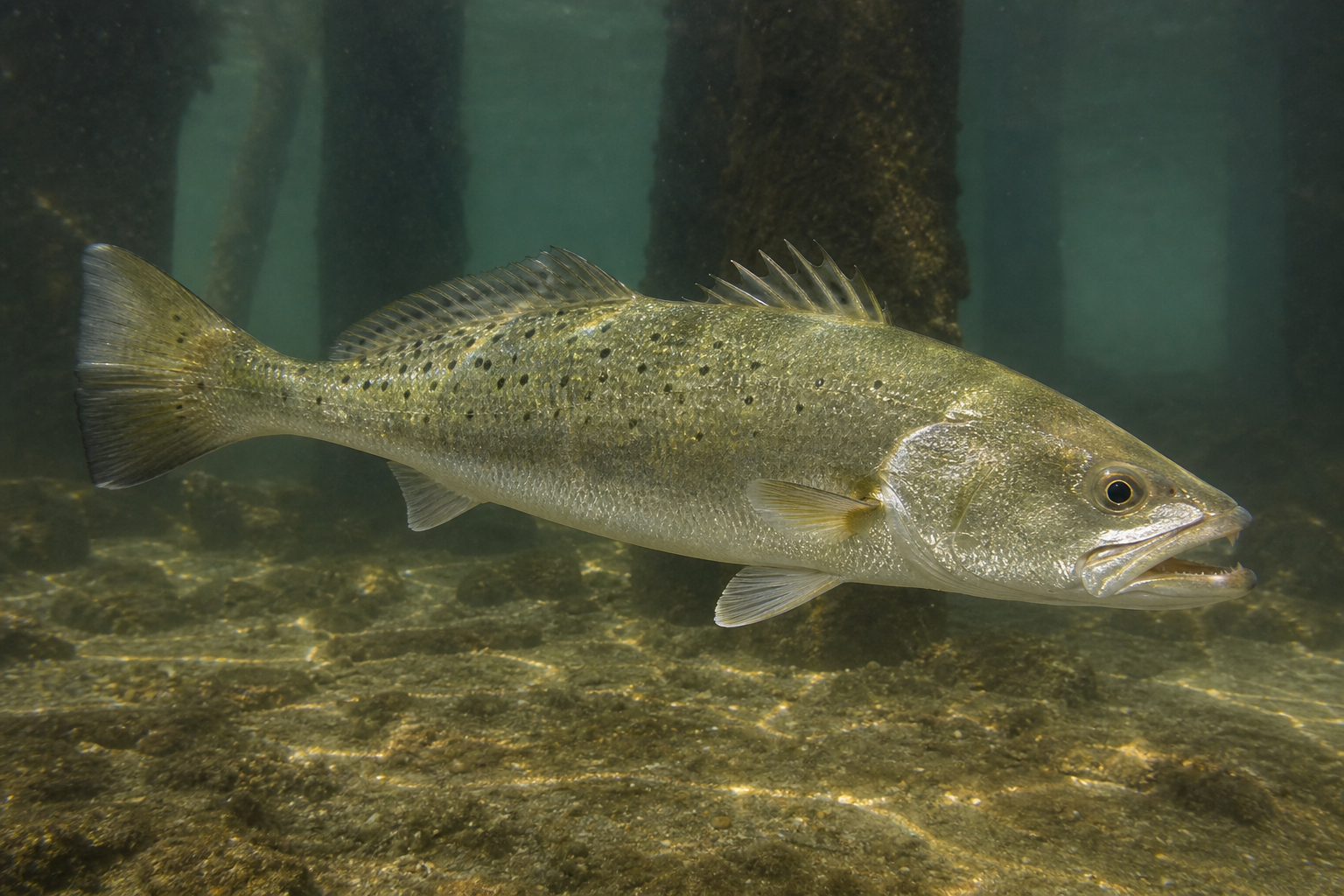
Weakfish
Identification
Weakfish — also known as gray trout or speckled trout (not to be confused with spotted seatrout) — are members of the drum family (Sciaenidae). They have an elongated, somewhat compressed body with a dark gray to olive-brown back, silvery sides, and a white belly. The sides are marked with numerous small dark spots that often form wavy diagonal lines, and the inside of the mouth is distinctly orange. Weakfish typically range from 12 to 18 inches and weigh 1 to 3 pounds on the OBX, though fish up to 6-8 pounds are caught occasionally. The name “weakfish” comes from the delicate membrane of the mouth, which tears easily — hooked weakfish are easily lost if too much pressure is applied.
Habitat and Behavior
Weakfish range from Nova Scotia to Florida, but they are most abundant from New York to North Carolina. They are found in estuaries, inlets, and nearshore coastal waters, typically in depths less than 50 feet. Weakfish are schooling predators that feed on small fish, shrimp, crabs, and squid. They are most active during low-light periods — dawn, dusk, and nighttime — when they move into shallower water to hunt. Weakfish populations have fluctuated dramatically over the decades, with periods of great abundance followed by sharp declines. In recent years, weakfish have been less common on the OBX than in their historical heyday, but they still provide quality fishing for those who target them specifically.
Fishing Techniques
Weakfish can be caught with both natural baits and artificial lures. For bait fishing, a two-hook bottom rig (spec rig) with small hooks (size 4 to 1) is the standard setup, fished on the bottom or suspended under a float. Float fishing live shrimp near pier pilings or in the surf can be deadly for weakfish. For lure fishing, soft plastic swimbaits, grub tails, and small bucktail jigs cast and retrieved near structure or in the surf can produce strikes. Spec rigs with bright colored plastics (pink, white, chartreuse) tipped with shrimp or squid strips are a classic OBX approach. Light spinning tackle (8-15 lb test) is ideal. Remember the weakfish’s soft mouth — use a gentle hook set and don’t apply too much pressure when fighting the fish.
Baits and Lures
Live or fresh shrimp is the top natural bait for weakfish on the OBX. Fished on the bottom or under a float, shrimp is hard to beat. Bloodworms and squid will also produce weakfish, though they are less selective. For artificial lures, soft plastic swimbaits in the 3-5 inch range are excellent — baits like Berkley Gulp, Zoom Flukes, and spec rig grubs in pink, white, and chartreuse are all proven producers. Small bucktail jigs (1/4 to 1 oz) tipped with shrimp or fished bare can also be effective. The key is matching the lure size to the typical forage — weakfish feed on small baitfish and shrimp, so keep lures modest in size.
Best Times and Locations on the OBX
Weakfish appear in OBX waters in late spring (May) and remain through October. They are most active during the summer months, particularly July and August. OBX piers — especially Avalon, Nags Head, and Jennette’s — produce weakfish, particularly at night and during early morning hours. Oregon Inlet and Hatteras Inlet are excellent for weakfish, as the moving tide concentrates baitfish and weakfish alike. The surf can produce weakfish at dawn and dusk, particularly near inlets and in the sloughs. Night fishing is a major factor for weakfish success — they are nocturnal feeders, and many of the best weakfish catches come after dark. A moving tide at night near an inlet or pier is the ideal scenario for weakfish on the OBX.
Regulations
Weakfish (gray trout) are managed by the Atlantic States Marine Fisheries Commission (ASMFC) and the NC Division of Marine Fisheries. The minimum size limit is 12 inches total length. The recreational daily bag limit is 7 fish per person. There is no closed season. Weakfish populations have been under pressure, so regulations may be tightened — always check current NC DMF rules before fishing.