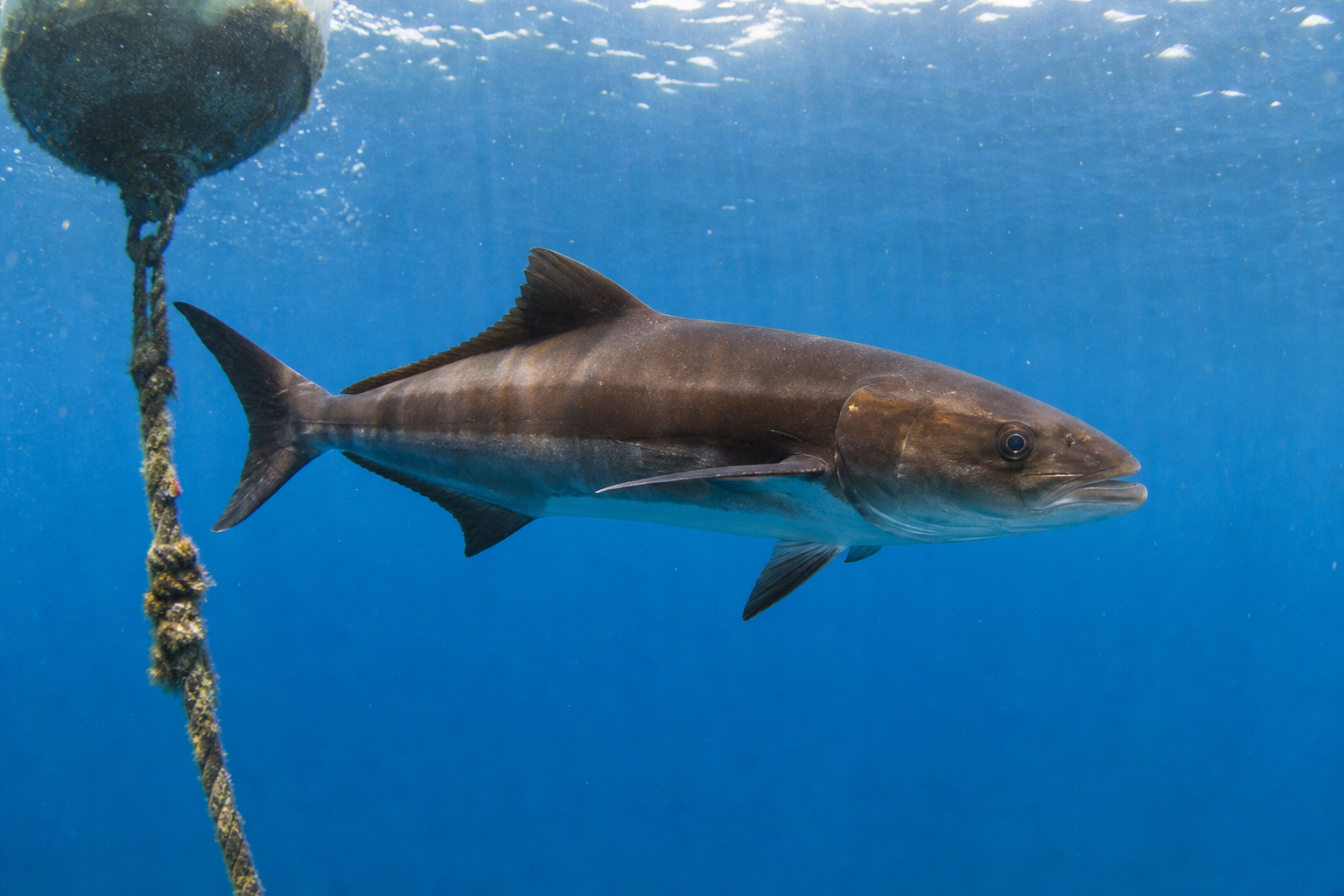
Cobia (Rachycentron canadum)
Cobia are one of the most exciting and prized game fish on the Outer Banks. Known for their powerful runs, aggressive strikes, and excellent table fare, cobia are a target species that draws anglers from across the East Coast. These brown-and-white fish are often seen cruising the surface, making them a favorite for sight-casters.
Identification
Cobia have a distinctive appearance: a long, cylindrical body, dark brown to black coloration with a white underside, and a prominent dark lateral stripe. They have a broad, flat head and a forked tail. Cobia are often mistaken for sharks when seen from above due to their dark coloration and cruising behavior. Adults typically range from 20 to 60 pounds, with trophy fish exceeding 80 pounds.
Cobia are the only member of the family Rachycentridae. They are closely related to remoras but lack the sucker disc. Their scientific name, Rachycentron canadum, reflects their unique taxonomic position. Despite their resemblance to sharks, cobia are actually related to jacks and dolphinfish.
Habitat and Behavior
Cobia are a warm-water species that migrate along the Atlantic coast. They arrive on the Outer Banks in late spring (typically May) as water temperatures rise above 68°F. They are highly structure-oriented fish, congregating around buoys, wrecks, reefs, and navigational markers. They also cruise sandbars, shoals, and inlet areas, often in small groups.
Cobia are known for their surface-cruising behavior. On calm days, they can be spotted swimming just below or at the surface, particularly around structure and in inlets. This makes them ideal for sight-casting — one of the most thrilling fishing experiences on the OBX. When hooked, cobia are powerful fighters known for long, strong runs and spectacular jumps.
Fishing Techniques
Sight Casting: The most exciting way to catch cobia is by sight-casting to fish cruising on the surface. Use a tower boat or stand on a pier to spot fish, then cast a jig or live bait ahead of the fish. Bucktail jigs (2–4 oz) with a plastic trailer are the most popular sight-casting lure.
Pier Fishing: OBX piers, particularly Avalon Pier and Jennette’s Pier, are productive for cobia during late spring and early summer. Anglers use heavy rods (50+ lb class) with live eels or large jigs. Look for cobia cruising near the surface around the pier structure.
Bottom Fishing: Cobia can be caught on the bottom around reefs, wrecks, and hard bottom areas. Use a fish-finder rig with live bait (croaker, crab, or eel). This is less visual but can be very effective.
Trolling: Slow-trolling live baits or large jigs around structure and inlets can produce cobia, particularly when fish are not visible on the surface.
Baits and Lures
Live eels are the gold standard cobia bait. They can be fished live on a fish-finder rig or under a float. Eels are available at most OBX tackle shops during cobia season.
Live croaker and spot are excellent bottom-fishing baits. Use a 7/0–9/0 circle hook with a fish-finder rig and enough weight to hold bottom.
Crabs, particularly blue crabs, are a natural cobia food source. Use them live on a bottom rig.
Bucktail jigs (2–4 oz) in white, chartreuse, or pink are the top artificial lures. Add a plastic trailer (swimbait or curl-tail grub) for extra action. Cast ahead of cruising fish and retrieve with a steady motion.
Live mullet can be fished live on a float rig or slow-trolled. They are effective when cobia are feeding on baitfish schools.
Tackle Recommendations
- Rod: 7-foot medium-heavy to heavy casting or spinning rod for sight-casting; 6.5–7.5 foot heavy rod for pier fishing
- Reel: Conventional or spinning reel with 30–50 lb braid and a smooth, strong drag
- Leader: 50–80 lb fluorocarbon or monofilament leader
- Hook: 7/0–9/0 circle hook for live bait; 5/0–7/0 for jigs
Best Times and Locations on the OBX
Cobia season on the Outer Banks runs from May through September, with the peak in late May through June. The best locations include:
- Oregon Inlet and Hatteras Inlet: Both inlets are cobia highways during the spring migration
- Avalon Pier (Kill Devil Hills): One of the best pier locations for cobia on the OBX
- Jennette’s Pier (Nags Head): Modern pier with excellent cobia fishing
- Hatteras Inlet: Charter boats run out of Hatteras for cobia in spring
- Nearshore wrecks and reefs: Bottom fishing for cobia around structure
Regulations
Cobia are managed by both federal and state regulations. In North Carolina, the recreational bag limit is 1 per person per day with a minimum size of 36 inches fork length. The commercial fishery has separate regulations. Seasons may be subject to closure based on quota — always check current NC Division of Marine Fisheries regulations before fishing. Cobia are a managed species and compliance is essential for the health of the fishery.
Cobia fishing on the Outer Banks is an experience every angler should try at least once. The combination of sight-casting excitement, powerful fights, and excellent eating makes cobia one of the most rewarding species to target on the OBX.