Your cart is empty
Start shopping to add items to your cart
COBIA
Cobia are the sight-casting fish of the spring. Spot one on the surface, put a jig in front of it, and hold on.
Sizing up the surf for cobia…
No live reading right now
Live buoy data is not answering, so read the table above. In May and June, a live eel or a bucktail jig fished around the inlets.
The live buoy page →Cobia arrive with the warm water in May and move through by September, peaking late May and June.
Each row below pairs a bait with its rig, its weight and the rod to cast it. Nothing on this table changes with the tide.
| Bait | Rig | Sinker weight | Rod and line |
|---|---|---|---|
| Live eel | Fish finder or float rig, 7/0-9/0 circle hook2-6 oz egg sinker7 ft heavy rod, 30-50 lb braid, 50-80 lb leaderThe gold standard, fished live around structure. | 2-6 oz egg sinker | 7 ft heavy rod, 30-50 lb braid, 50-80 lb leader |
| Bucktail jig with a trailer (2-4 oz) | Direct to the leader, 5/0-7/0 hookNo sinker, cast ahead of a cruising fish7 ft medium-heavy casting rod, 30 lb braid, 50 lb leaderThe sight-casting lure. Cast ahead of the fish, not at it. | No sinker, cast ahead of a cruising fish | 7 ft medium-heavy casting rod, 30 lb braid, 50 lb leader |
| Live croaker or spot | Fish finder, 7/0-9/0 circle hookEnough to hold bottom7 ft heavy rod, 40 lb braid, 60 lb leaderFor cobia holding on wrecks and hard bottom. | Enough to hold bottom | 7 ft heavy rod, 40 lb braid, 60 lb leader |
| Live blue crab | Fish finder, 8/0 circle hook3-6 oz sinker7 ft heavy rod, 40 lb braid, 60 lb leaderA natural food source around the reefs and inlets. | 3-6 oz sinker | 7 ft heavy rod, 40 lb braid, 60 lb leader |
Where cobia turn up on this stretch of coast, and what the water is doing there today.
Lead the fish. A cobia cruising the surface will not turn for a lure that lands behind it.
Fish the inlet edges on the falling tide in late May and June. The migration funnels through there.
Keep the rod loaded and the drag set. Cobia make long, hard runs, and a loose drag just costs you line.
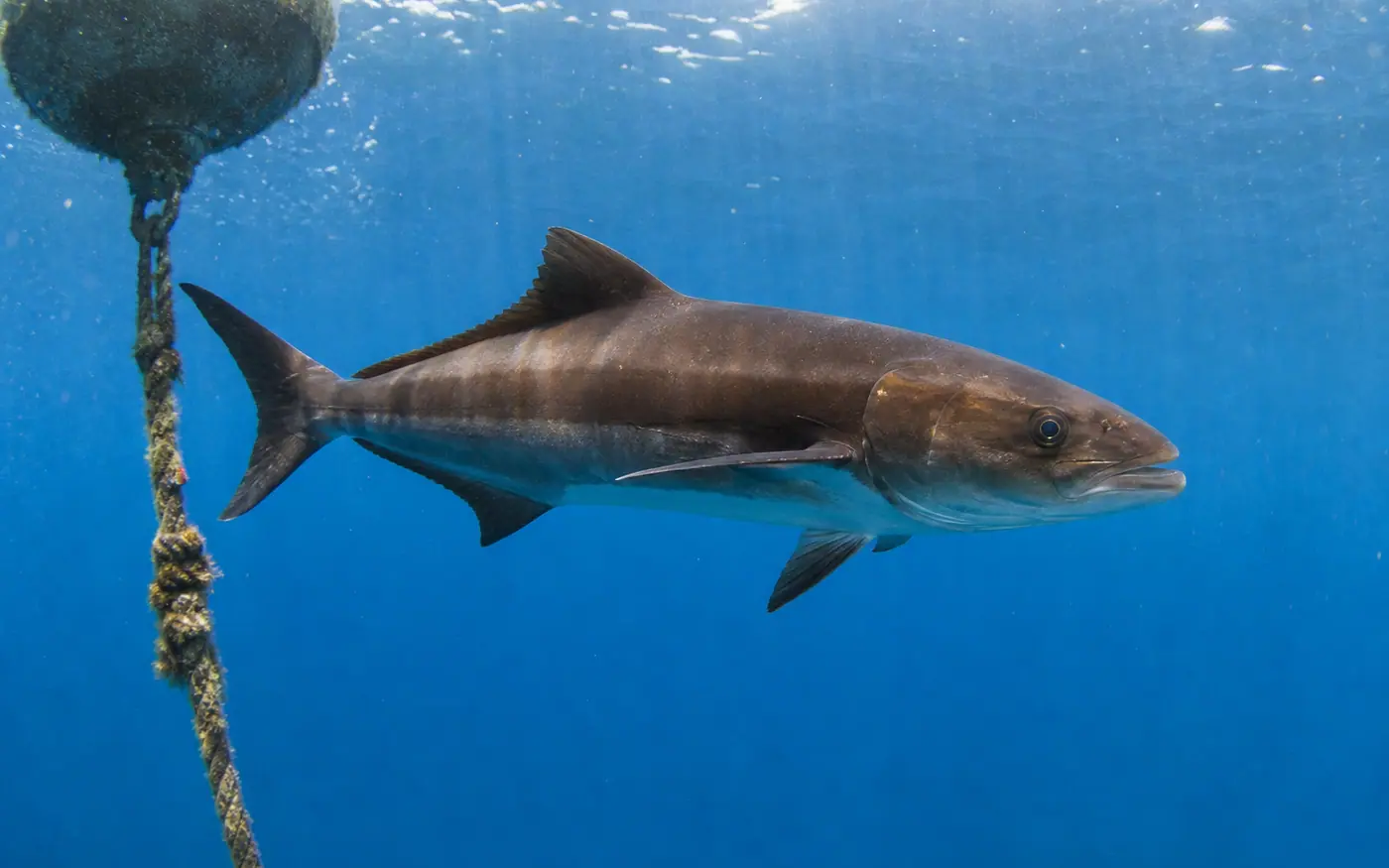
Cobia are the cruising brown shadows that turn a day of looking into a day of adrenaline. They travel alone or in loose pairs, often right on the surface, and the angler who spots one first usually wins. A live bait or a big soft plastic dropped ahead of a moving fish and worked away from it will draw a strike; casting behind it rarely does. They shadow rays, buoys, wrecks and the backs of sharks, so any dark shape on the surface deserves a second look. They hit hard and run, so gear has to be heavy enough to turn a fish that wants open water. Keep the sun behind you and your eyes on the surface. A heavy rod rigged and ready matters, because a cobia rarely gives a second cast once it decides the bait is worth taking. Scan the weed lines and the colour breaks as well as the surface, because a cruising fish often shows only a fin or a shadow. They will eat a hooked fish on the line, so keep a bait ready even after the first hookup.
2 boxes carried straight from the state rule page. Measure before it goes on ice.
| Rule | Limit |
|---|---|
| Size | 36 in minimum (fork length) |
| Bag limit | 1 per person per day |
| The season can close on quota, so check the current proclamation. | |
Updated Oct 30, 2026